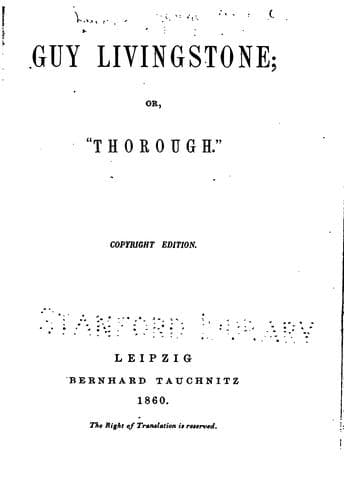
Guy Livingstone; or, 'Thorough'Lawrence, George A. (George Alfred)
General
Guy Livingstone; or, 'Thorough'
Lawrence, George A. (George Alfred)
Fiction
Good King Arthur is gone. It bit deep, that blow which Mordred, the
strong traitor, struck when the spear stood out a fathom behind his
back; and Morgan la Fay came too late to heal the grievous wound that
had taken cold. The frank, kind, generous heart, that would not mistrust
till certainty left no space for suspicion, can never be wrung or
betrayed again. The bitter parting between the lovers is over too; and
Launcelot is gone to his own place, without the farewell caress he
prayed for when he besought the queen "to kiss him once and never more."
After a very few short months, the beautiful wild bird has beaten
herself to death against her cage, and the vision comes by night,
bidding Launcelot arise and fetch the corpse of Guenever home. She
wandered often and far in life, but where should her home be _now_ but
by the side of her husband? Hardly and painfully in two days, he and
the faithful seven accomplish the thirty miles that lay between; so
utterly is that unearthly strength, before which lance-shafts were as
reeds, and iron bars as silken threads (remember the May night in
Meliagraunce's castle), enfeebled and broken down. He stands in the
nunnery-church at Almesbury; he hears from the queen's maidens of the
prayer that was ever on her lips through those two days when she lay a
dying, how "she besought God that she might never have power to see Sir
Launcelot with her worldly eyes." Then, says the chronicler, "he saw her
visage; yet he wept not greatly, but sighed. And so he did all the
observance of the service himself, both the dirge at night and the mass
on the morrow." Not till every rite was performed, not till the earth
had closed over the marble coffin, did Launcelot swoon.
I know nothing in fiction so piteous as the words that tell of his
dreary, mortal sorrow. "Then, Sir Launcelot never after ate but little
meat, nor drank, but continually mourned until he was dead; and then he
sickened more and more, and dried and dwined away; for the bishop nor
none of his fellows might make him to eat, and little he drank; so that
he waxed shorter by a cubit than he was, and the people could not know
him; for evermore day and night he prayed; but needfully as nature
required, sometimes he slumbered a broken sleep; and always he was lying
groveling on King Arthur's and Queen Guenever's tomb. And there was no
comfort that his fellows could make him; it availed nothing."
We know it can not last long; we know that the morning is fast
approaching, when they will find him "stark dead, and lying as he had
smiled;" when they will bear him forth, according to his vow, to his
resting-place in Joyous Guard; when there will be pronounced over him
that famous funeral oration--the truest, the simplest, the noblest, I
think, that ever was spoken over the body of a sinful man.
CHAPTER XXXI.
"I pray God pardon me,
That I no more, without a pang,
His choicest works can see."
Public-domain text, read in full here on John Shaqi.
Reviews
Reviews
No reviews yet
Be the first to share your thoughts on this work.
Elsewhere in the archive
Join the Discussion
Join the discussion
Sign in to leave a comment or review.
Sign InorCreate an account