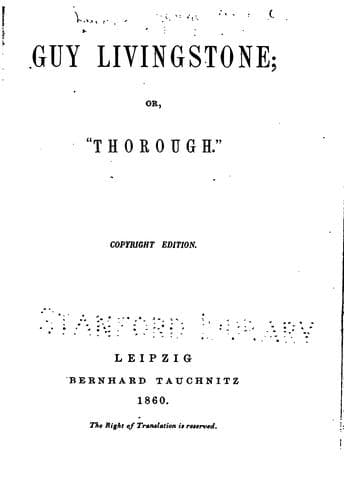
Guy Livingstone; or, 'Thorough'Lawrence, George A. (George Alfred)
General
Guy Livingstone; or, 'Thorough'
Lawrence, George A. (George Alfred)
Fiction
A German philosopher under similar circumstances would have written
reams and spoken volumes (eating and drinking all the while
Pantagruelically), theorizing and abstracting his emotions till they
vanished into cloud and vapor. A true disciple of Rousseau or Lamartine
would have analyzed his grief, dividing it into as many channels as
Alexander did the Oxus, till the main stream was lost, and each
individual rivulet might be crossed dry-shod. Both would have shed tears
perpetual and profuse. I read the other day of a Frenchman who, in the
midst of a mixed assembly, remembering that on that day ten years he had
lost a dear friend, instantly went out and wept bitterly. He was so
charmed with the happiness of the thought that, as he says, "I took the
resolution henceforth to weep for all whom I have loved, each on the
anniversary of their death."
Can you conceive any thing more touching than the picture of the
Bereaved One consulting his almanac and then "going at it with a will?"
It _was_ an athletic performance certainly; but remember what condition
he must have been in from the constant training.
From the episode of Niobe down to the best song in the "Princess," how
many beautiful lines have been devoted to those outward and visible
signs of sorrow?
Sadder elegiacs, more pathetic threnodies might have been written on the
tears that were stifled at their source, either from pride or from
physical inability to let them flow. Great regrets, like great schemes,
are generally matured in the shade. If I had to choose the tombs where
most hopes and affections are buried, I should turn, I think, not to
those with the long inscriptions of questionable poetry or blameless
Latinity, but to where just the initials and a cross are cut on the
single stone.
The philosophical and poetical mourners hardly suffered much more than
Guy did during those months, and for long after too, though he was
always quite silent on the subject, and would speak cheerfully on others
now and then, and though, from the day that he parted with Constance to
that of his own death, his eyes were as dry as the skies over the Delta.
He used to lie for hours in that state of utter listlessness which
gives a reality to the sad old Eastern proverb, "Man is better sitting
than standing, lying down than sitting, dead than lying down."
With all this, however, his health improved every day. After the wild
life he had led lately, the perfect rest and the clear pure air
refreshed him marvelously. It had the effect of coming out of a room
heated and laden with smoke into the cool summer morning. His strength,
too, had returned almost completely. I found this out at Baiae.
Public-domain text, read in full here on John Shaqi.
Reviews
Reviews
No reviews yet
Be the first to share your thoughts on this work.
Elsewhere in the archive
Join the Discussion
Join the discussion
Sign in to leave a comment or review.
Sign InorCreate an account