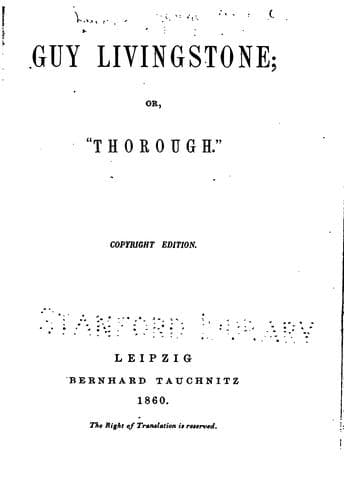
Guy Livingstone; or, 'Thorough'Lawrence, George A. (George Alfred)
General
Guy Livingstone; or, 'Thorough'
Lawrence, George A. (George Alfred)
Fiction
She was rarely lovely, certainly, as I was sure she would be, for Guy's
taste in feminine beauty was undisputed. Her features were delicate, but
very clearly cut; the nose and chin purely Grecian in their outline; the
dark gray eyes met you with an earnest, true expression, as if they had
nothing to conceal. Her broad Spanish hat suited her well, shading as it
did cheeks slightly flushed by exercise, and shining tresses of that
color which with us is nameless, and which across the Channel they
call--_blond cendre_. Her hand was strikingly perfect, even in its
gauntlet. It might have been modeled from that famous marble fragment of
which the banker-poet was so proud, and which Canova kissed so often.
There is a face which always reminds me of hers, though the figure in
the portrait is far more matured and developed than Constance's willowy
form--the picture of Queen Joanna of Naples in the Palazzo Doria.
I have stood before it long, trying in vain to read the riddle of the
haughty lineaments, and serene, untroubled eyes. Gazing at these, who
could guess the story of that most guilty woman and astute
conspirator--unbridled in sensuality--remorseless in statecraft--who
counted her lovers by legions, and saw, unmoved, her chief favorite torn
limb from limb on the rack?
But this is no singular instance. Marble and canvas are more discreet
than the mask of the best trained living features. Messalina and Julia
look cold and correct enough since they have been turned into stone.
Only by the magic of her smile and by the glory of her golden hair do we
recognize her who, if all tales are true, might have given a tongue to
the walls of the Vatican. We forget the Borgia, with her laboratory of
philtres and poisons--we only think that never a duke of all his royal
race brought home a lovelier bride than Alfonso of Ferrara.
Perhaps it is best so. Why should a mark be set upon those whom, it may
be, history has condemned unrighteously? Let us not be more uncharitable
than the painter or the sculptor, but pass on without pausing to
reflect--_Desinit in piscem_.
Public-domain text, read in full here on John Shaqi.
Reviews
Reviews
No reviews yet
Be the first to share your thoughts on this work.
Elsewhere in the archive
Join the Discussion
Join the discussion
Sign in to leave a comment or review.
Sign InorCreate an account