There is an old prejudice in these hills in favour of riding. Every
farmer rides well, and rides the whole day. Probably the extent of
their large pasture farms, and the necessity of surveying them
rapidly, first introduced this custom; or a very zealous antiquary
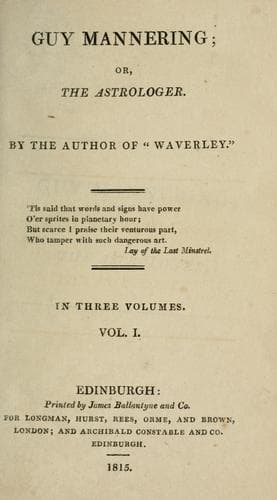
might derive it from the times of the Lay o the Last Minstrel, when
twenty thousand horsemen assembled at the light of the
beacon-fires. [*It would be affectation to alter this reference.
But the reader will understand it was inserted to keep up the
author's incognito, as he was not likely to be suspected of quoting
his own works. This explanation is also applicable to one or two
similar passages, in this and the other novels, introduced for the
same reason.] But the truth is undeniable; they like to be on
horseback, and can be with difficulty convinced that any one
chooses walking from other motives than those of convenience or
necessity. Accordingly, Dinmont insisted upon mounting his guest,
and accompanying him on horseback as far as the nearest town in
Dumfriesshire, where he had directed his baggage to be sent, and
from which he proposed to pursue his intended journey towards
Woodbourne, the residence of Julia Mannering.
Upon the way he questioned his companion concerning the character
of the fox-hunter; but gained little information, as he had been
called to that office while Dinmont was making the round of the
Highland fairs. "He was a shake-rag like fellow," he said, "and,
he dared to say, had gipsy blood in his veins--but at ony rate he
was nane o' the smacks [*Rogues] that had been on their quarters
in the moss--he would ken them weel if he saw them again. There
are some no bad folk amang the gipsies too, to be sic a gang,"
added Dandie; "if ever I see that auld randle-tree of a wife again,
I'll gie her something to buy tobacco--I have a great notion she
meant me very fair after a'."
When they were about finally to part, the good farmer held Brown
long by the hand, and at length said, "Captain, the woo's sae weel
up the year that it's paid a' the rent, and we have naething to do
wi' the rest o' the siller when Ailie has had her new gown, and the
bairns their bits o' duds [*Clothes]--now I was thinking of some
safe hand to put it into, for it's ower muckle to ware on brandy
and sugar--now I have heard that you army gentlemen can sometimes
buy yoursells up a step; and if a hundred or twa would help ye on
such an occasion, the bit scrape o' your pen would be as good to me
as the siller, and ye might just take yere ane time o' settling
it--it wad be a great convenience to me." Brown, who felt the full
delicacy that wished to disguise the conferring an obligation under
the show of asking a favour, thanked his grateful friend most
heartily, and assured him he would have recourse to his purse,
without scruple, should circumstances ever render it convenient for
him. And thus they parted with many expressions of mutual regard.
CHAPTER XXVII.
Public-domain text, read in full here on John Shaqi.
Reviews
Reviews
No reviews yet
Be the first to share your thoughts on this work.
Elsewhere in the archive
Join the Discussion
Join the discussion
Sign in to leave a comment or review.
Sign InorCreate an account