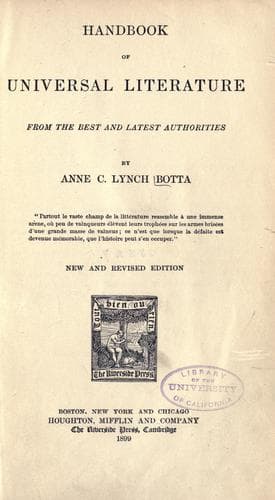
Handbook of Universal Literature, From the Best and Latest AuthoritiesBotta, Anne C. Lynch (Anne Charlotte Lynch)
History
Handbook of Universal Literature, From the Best and Latest Authorities
Botta, Anne C. Lynch (Anne Charlotte Lynch)
Literature -- History and criticism
If we carry ourselves in imagination back to a time when dramatic
composition was unknown, we must acknowledge that its creation required
great boldness of mind. Hitherto the bard had only sung of gods and
heroes; it was, therefore, a great change for the poet himself to come
forward all at once in the character of the god or hero, in a nation
which, even in its amusements, had always adhered closely to established
usages. It is true that there is much in human nature which impels it to
dramatic representations, such as the universal love of imitating other
persons, and the child-like liveliness with which a narrator, strongly
impressed with his subject, delivers a speech which he has heard or
perhaps only imagined. Yet there is a wide step from these disjointed
elements to the genuine drama, and it seems that no nation, except the
Greeks, ever made this step. The dramatic poetry of the Hindus belongs to
a time when there had been much intercourse between Greece and India; even
in ancient Greece and Italy, dramatic poetry, and especially tragedy,
attained to perfection only in Athens, and here it was exhibited only at a
few festivals of a single god, Dionysus, while epic rhapsodies and lyric
odes were recited on various occasions. All this is incomprehensible, if
we suppose dramatic poetry to have originated in causes independent of the
peculiar circumstances of time and place. If a love of imitation and a
delight in disguising the real person under a mask were the basis upon
which this style of poetry was raised, the drama would have been as
natural and as universal among men as these qualities are common to their
nature.
Public-domain text, read in full here on John Shaqi.
Reviews
Reviews
No reviews yet
Be the first to share your thoughts on this work.
Elsewhere in the archive
Join the Discussion
Join the discussion
Sign in to leave a comment or review.
Sign InorCreate an account