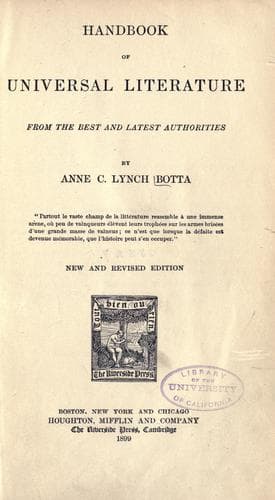
Handbook of Universal Literature, From the Best and Latest AuthoritiesBotta, Anne C. Lynch (Anne Charlotte Lynch)
History
Handbook of Universal Literature, From the Best and Latest Authorities
Botta, Anne C. Lynch (Anne Charlotte Lynch)
Literature -- History and criticism
legislative influence strove in vain to counteract the predominance of
Greek philosophy and eloquence. But this imitative tendency was tempered
by the pride of Roman citizenship. That sentiment breaks out, not merely
in the works of great statesmen and warriors, but quite as strikingly in
the productions of those in whom the literary character was all in all. It
is as prominent in Virgil and Horace as in Cicero and Caesar; and if the
language of Rome, in other respects so inferior to that of Greece, has any
advantage over the sister tongue, it lies in that accent of dignity and
command which seems inherent in its tones. The austerity of power is not
shaded down by those graceful softenings so agreeable to the disposition
of the most polished Grecian communities. In the Latin forms and syntax we
are everywhere conscious of a certain energetic majesty and forcible
compression. We hear, as it were, the voice of one who claims to be
respected, and resolves to be obeyed.
The Roman classical literature may be divided into three periods. The
first embraces its rise and progress, oral and traditional compositions,
the rude elements of the drama, the introduction of Greek literature, and
the construction and perfection of comedy. To this period the first five
centuries of the republic may be considered as introductory, for Rome had,
properly speaking, no literature until the conclusion of the first Punic
war (241 B.C.), and the first period, commencing at that time, extends
through 160 years--that is, to the first appearance of Cicero in public
life, 74 B.C.
The second period ends with the death of Augustus, 14 A.D. It comprehends
the age of which Cicero is the representative as the most accomplished
orator, philosopher, and prose-writer of his time, as well as that of
Augustus, which is commonly called the Golden Age of Latin poetry.
The third and last period terminates with the death of Theodoric, 526 A.D.
Notwithstanding the numerous excellences which distinguished the
literature of this time, its decline had evidently commenced, and, as the
age of Augustus has been distinguished by the epithet "golden," the
succeeding period, to the death of Hadrian, 138 A.D., on account of its
comparative inferiority, has been designated "the Silver Age." From this
time to the close of the reign of Theodoric, only a few distinguished
names are to be found.
2. THE LANGUAGE.--The origin of the Latin language is necessarily
connected with that of the Romans themselves. In the most distant ages to
which tradition extends, Italy appears to have been inhabited by three
stocks or tribes of the great Indo-European family. One of these is
commonly known by the name of Oscans; another consisted of two branches,
the Sabelians or Sabines, and the Umbrians; the third was called Sikeli,
sometimes Vituli or Itali.
Public-domain text, read in full here on John Shaqi.
Reviews
Reviews
No reviews yet
Be the first to share your thoughts on this work.
Elsewhere in the archive
Join the Discussion
Join the discussion
Sign in to leave a comment or review.
Sign InorCreate an account