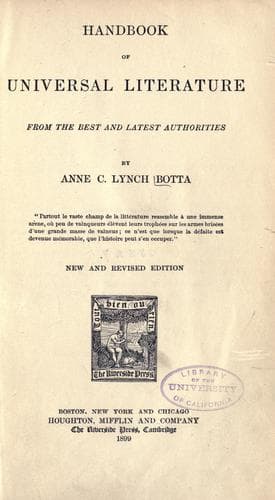
Handbook of Universal Literature, From the Best and Latest AuthoritiesBotta, Anne C. Lynch (Anne Charlotte Lynch)
History
Handbook of Universal Literature, From the Best and Latest Authorities
Botta, Anne C. Lynch (Anne Charlotte Lynch)
Literature -- History and criticism
4. COMIC POETS.--Plautus (227-184 B.C.) was a contemporary of Ennius; he
was a native of Umbria, and of humble origin. Education did not overcome
his vulgarity, although it produced a great effect upon his language and
style. He must have lived and associated with the people whose manners he
describes, hence his pictures are correct and truthful. The class from
which his representations are taken consisted of clients, the sons of
freedmen and the half-enfranchised natives of Italian towns. He had no
aristocratic friends, like Ennius and Terence; the Roman public were his
patrons, and notwithstanding their faults, his comedies retained their
popularity even in the Augustan age, and were acted as late as the reign
of Diocletian. Life, bustle, surprise, unexpected situations, sharp,
sparkling raillery that knew no restraint nor bound, left his audience no
time for dullness or weariness. Although Greek was the fountain from which
he drew his stores, his wit, thought, and language were entirely Roman,
and his style was Latin of the purest and most elegant kind--not, indeed,
controlled by much deference to the laws of metrical harmony, but full of
pith and sprightliness, bearing the stamp of colloquial vivacity, and
suitable to the general briskness of his scenes. Yet in the tone of his
dialogue we miss all symptoms of deference to the taste of the more
polished classes of society. Almost all his comedies were adopted from the
new comedy of the Greeks, and though he had studied both the old and the
middle comedy, Menander and others of the same school furnished him the
originals of his plots. The popularity of Plautus was not confined to
Rome, either republican or imperial. Dramatic writers of modern times, as
Shakspeare, Dryden, and Molière, have recognized the effectiveness of his
plots, and have adopted or imitated them. About twenty of his plays are
extant, among which the Captivi, the Epidicus, the Cistellaria, the
Aulularia, and the Rudens are considered the best.
Terence (193-158 B.C.) was a slave in the family of a Roman senator, and
was probably a native of Carthage. His genius presented the rare
combination of all the fine and delicate qualities which characterized
Attic sentiment, without corrupting the native purity of the Latin
language. The elegance and gracefulness of his style show that the
conversation of the accomplished society, in which he was a welcome guest,
was not lost upon his correct ear and quick intuition. So far as it can be
so, comedy was, in the hands of Terence, an instrument of moral teaching.
Six of his comedies only remain, of which the Andrian and the Adelphi are
the most interesting. If Terence was inferior to Plautus in life, bustle,
and intrigue, and in the delineation of national character, he is superior
in elegance of language and refinement of taste. The justness of his
reflections more than compensates for the absence of his predecessor's
humor; he touches the heart as well as gratifies the intellect.
Public-domain text, read in full here on John Shaqi.
Reviews
Reviews
No reviews yet
Be the first to share your thoughts on this work.
Elsewhere in the archive
Join the Discussion
Join the discussion
Sign in to leave a comment or review.
Sign InorCreate an account