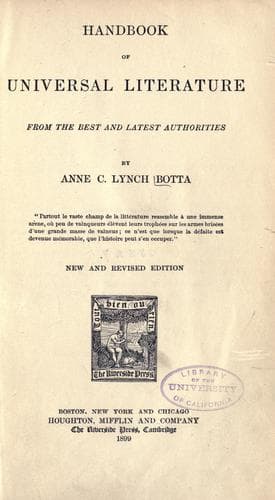
Handbook of Universal Literature, From the Best and Latest AuthoritiesBotta, Anne C. Lynch (Anne Charlotte Lynch)
History
Handbook of Universal Literature, From the Best and Latest Authorities
Botta, Anne C. Lynch (Anne Charlotte Lynch)
Literature -- History and criticism
The fairy mythology of the Arabians was introduced into Europe in the
eleventh century by the Troubadours and writers of the romances of
chivalry, and through them it became an important element in the
literature of Europe. It constituted the machinery of the _Fabliaux_ of
the Trouvères, and of the romantic epics of Boccaccio, Ariosto, Tasso,
Spenser, Shakspeare, and others.
The three leading Mohammedan sects are the Sunnees, the Sheahs, and the
Wahabees. The Sunnees acknowledge the authority of the first Caliphs, from
whom most of the traditions were derived. The Sheahs assert the divine
right of Ali to succeed to the prophet; consequently they consider the
first Caliphs, and all their successors, as usurpers. The Wahabees are a
sect of religious reformers, who took their name from Abd al Wahab (1700-
1750), the Luther of the Mohammedans. They became a formidable power in
Arabia, but they were finally overcome by Ibrahim Pacha in 1816.
4. HISTORICAL DEVELOPMENT OF THE ARABIAN LITERATURE.--The literature of
the Arabians has, properly speaking, but one period; although from remote
antiquity poetry was with them a favorite occupation, and long before the
time of Mohammed the roving tribes of the desert had their annual
conventions, where they defended their honor and celebrated their heroic
deeds. As early as the fifth century A.D., at the fair of Ochadh, thirty
days every year were employed not only in the exchange of merchandise, but
in the nobler display of rival talents. A place was set apart for the
competitions of the bards, whose highest ambition was to conquer in this
literary arena, and the victorious compositions were inscribed in golden
letters upon Egyptian paper, and suspended upon the doors of the Caaba,
the ancient national sanctuary of Mecca. Seven of the most famous of these
ancient poets have been celebrated by Oriental writers under the title of
the Arabian Pleiades, and their songs, still preserved, are full of
passion, manly pride, and intensity of imagination and feeling. These and
similar effusions constituted the entire literature of Arabia, and were
the only archives of the nation previous to the age of Mohammed.
The peninsula of Arabia, hitherto restricted to its natural boundaries,
and peopled by wandering tribes, had occupied but a subordinate place in
the history of the world. But the success of Mohammed and the preaching of
the Koran were followed by the union of the tribes who, inspired by the
feelings of national pride and religious fervor, in less than a century
made the Arabian power, tongue, and religion predominant over a third part
of Asia, almost one half of Africa, and a part of Spain; and, from the
ninth to the sixteenth century, the literature of the Arabians far
surpassed that of any contemporary nation.
Public-domain text, read in full here on John Shaqi.
Reviews
Reviews
No reviews yet
Be the first to share your thoughts on this work.
Elsewhere in the archive
Join the Discussion
Join the discussion
Sign in to leave a comment or review.
Sign InorCreate an account