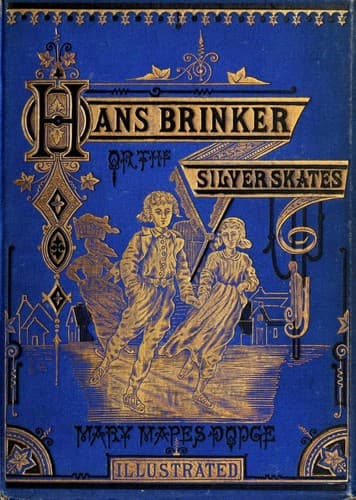
Hans Brinker; Or, The Silver SkatesDodge, Mary Mapes
History
Hans Brinker; Or, The Silver Skates
Dodge, Mary Mapes
Netherlands -- History -- 19th century -- Juvenile fiction; Siblings -- Juvenile fiction; Skating -- Juvenile fiction
"What of that?" said the vrouw, kindling again. "It is no sin to love
beautiful things, if you adapt your material to circumstances. All _I_
have to say is, the women saved their country and, indirectly,
introduced a very important branch of manufacture. Is not that so,
Jasper?"
"Of course it is, sweetheart," said mynheer, "but Peter needs no word of
mine to convince him that all the world over, women have never been
found wanting in their country's hour of trial, though (bowing to
Mevrouw) his own countrywomen stand foremost in the records of female
patriotism and devotion."
Then turning to Ben, the host talked with him in English of the fine old
Belgian city. Among other things, he told the origin of its name. Ben
had been taught that Antwerp was derived from _ae'nt werf_ (on the
wharf), but Mynheer van Gend gave him a far more interesting derivation.
It appears that about three thousand years ago, a great giant, named
Antigonus, lived on the river Scheld, on the site of the present city
of Antwerp. This giant claimed half the merchandise of all navigators
who passed his castle. Of course some were inclined to oppose this
simple regulation. In such cases, Antigonus, by way of teaching them to
practice better manners next time, cut off and threw into the river the
right hands of the merchants. Thus hand-werpen (or hand-throwing),
changed to Antwerp, came to be the name of the place. The escutcheon or
arms of the city has two hands upon it; what better proof than this
could one have of the truth of the story, especially when one wishes to
believe it!
The giant was finally conquered and thrown into the Scheld by a hero
called Brabo, who in turn gave a name to the district known as Brabant.
Since then the Dutch merchants have traveled the river in peace; but I
for one thank old Antigonus for giving the city so romantic an origin.
When Mynheer van Gend had related in two languages this story of
Antwerp, he was tempted to tell other legends--some in English, some in
Dutch; and so the moments, borne upon the swift shoulders of gnomes and
giants, glided rapidly away toward bedtime.
It was hard to break up so pleasant a party, but the Van Gend household
moved with the regularity of clockwork. There was no lingering at the
threshold when the cordial "good-night!" was spoken. Even while our boys
were mounting the stairs, the invisible household fairies again
clustered around them, whispering that system and regularity had been
chief builders of the master's prosperity.
Beautiful chambers with three beds in them, were not to be found in
this mansion. Some of the rooms contained two, but each visitor slept
alone. Before morning, the motto of the party evidently was, "every boy
his own chrysalis"--and Peter, at least, was not sorry to have it so.
Public-domain text, read in full here on John Shaqi.
Reviews
Reviews
No reviews yet
Be the first to share your thoughts on this work.
Elsewhere in the archive
Join the Discussion
Join the discussion
Sign in to leave a comment or review.
Sign InorCreate an account