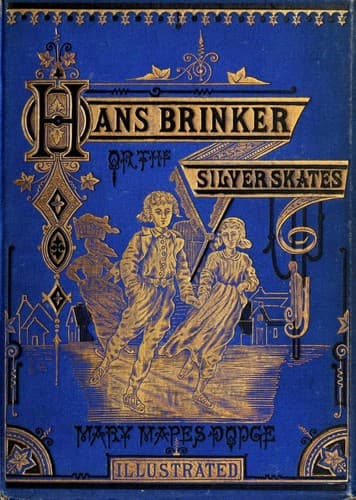
Hans Brinker; Or, The Silver SkatesDodge, Mary Mapes
History
Hans Brinker; Or, The Silver Skates
Dodge, Mary Mapes
Netherlands -- History -- 19th century -- Juvenile fiction; Siblings -- Juvenile fiction; Skating -- Juvenile fiction
"Good day, my boy!" cried the doctor, as he sprang into his stately
coach.
"Aha!" thought Hans, as it rolled away, "the meester has more life in
him than I thought."
XLIV
THE RACE
The Twentieth of December came at last, bringing with it the perfection
of winter weather. All over the level landscape lay the warm sunlight.
It tried its power on lake, canal and river; but the ice flashed
defiance and showed no sign of melting. The very weather-cocks stood
still to enjoy the sight. This gave the windmills a holiday. Nearly all
the past week they had been whirling briskly; now, being rather out of
breath, they rocked lazily in the clear, still air. Catch a windmill
working when the weather-cocks have nothing to do!
There was an end to grinding, crushing and sawing for that day. It was a
good thing for the millers near Broek. Long before noon they concluded
to take in their sails, and go to the race. Everybody would be
there--already the north side of the frozen Y was bordered with eager
spectators; the news of the great skating match had traveled far and
wide. Men, women, and children in holiday attire were flocking toward
the spot. Some wore furs, and wintry cloaks or shawls; but many,
consulting their feelings rather than the almanac, were dressed as for
an October day.
The site selected for the race was a faultless plain of ice near
Amsterdam, on that great _arm_ of the Zuider Zee which Dutchmen of
course must call--the Eye. The townspeople turned out in large numbers.
Strangers in the city deemed it a fine chance to see what was to be
seen. Many a peasant from the northward had wisely chosen the Twentieth
as the day for the next city-trading. It seemed that everybody, young
and old, who had wheels, skates or feet at command, had hastened to the
scene.
There were the gentry in their coaches, dressed like Parisians, fresh
from the Boulevards; Amsterdam children in charity uniforms; girls from
the Roman Catholic Orphan House, in sable gowns and white head-bands;
boys from the Burgher Asylum, with their black tights and short-skirted,
harlequin coats.[29] There were old-fashioned gentlemen in cocked hats
and velvet knee-breeches; old-fashioned ladies, too, in stiff, quilted
skirts and bodies of dazzling brocade. These were accompanied by
servants bearing foot-stoves and cloaks. There were the peasant folk
arrayed in every possible Dutch costume--Shy young rustics in brazen
buckles; simple village maidens concealing their flaxen hair under
fillets of gold; women whose long, narrow aprons were stiff with
embroidery; women with short, corkscrew curls hanging over their
foreheads; women with shaved heads and close-fitting caps, and women in
striped skirts and windmill bonnets. Men in leather, in homespun, in
velvet and broadcloth; burghers in model European attire, and burghers
in short jackets, wide trousers and steeple-crowned hats.
Public-domain text, read in full here on John Shaqi.
Reviews
Reviews
No reviews yet
Be the first to share your thoughts on this work.
Elsewhere in the archive
Join the Discussion
Join the discussion
Sign in to leave a comment or review.
Sign InorCreate an account