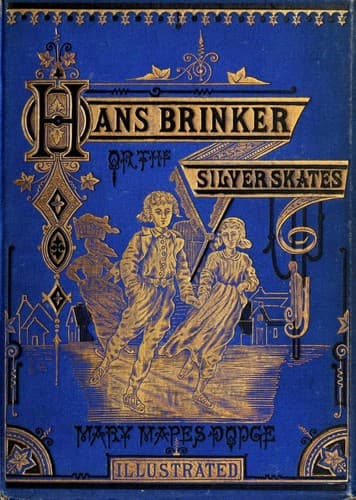
Hans Brinker; Or, The Silver SkatesDodge, Mary Mapes
History
Hans Brinker; Or, The Silver Skates
Dodge, Mary Mapes
Netherlands -- History -- 19th century -- Juvenile fiction; Siblings -- Juvenile fiction; Skating -- Juvenile fiction
arose concerning their expenses, the captain marched his company off to
bed, led on by a greasy pioneer-boy who carried skates and a candlestick
instead of an axe.
One of the ill-favored men by the fire had shuffled toward the dresser,
and was ordering a mug of beer, just as Ludwig, who brought up the rear,
was stepping from the apartment.
"I don't like that fellow's eye," he whispered to Carl; "he looks like a
pirate, or something of that kind."
"Looks like a granny!" answered Carl in sleepy disdain.
Ludwig laughed uneasily.
"Granny or no granny," he whispered, "I tell you he looks just like one
of those men in the 'voetspoelen.'"
"Pooh!" sneered Carl, "I knew it. That picture was too much for you.
Look sharp now, and see if yon fellow with the candle doesn't look like
the other villain."
"No, indeed, his face is as honest as a Gouda cheese. But, I say, Carl,
that really was a horrid picture."
"Humph! What did you stare at it so long for?"
"I couldn't help it."
By this time the boys had reached the "beautiful room with three beds in
it." A dumpy little maiden with long earrings met them at the doorway,
dropped them a courtesy, and passed out. She carried a long-handled
thing that resembled a frying-pan with a cover.
"I am glad to see that," said Van Mounen to Ben.
"What?"
"Why, the warming-pan. It's full of hot ashes; she's been heating our
beds."
"Oh! a warming-pan, eh! Much obliged to her, I'm sure," said Ben, too
sleepy to make any further comment.
Meantime, Ludwig still talked of the picture that had made such a strong
impression upon him. He had seen it in a shop window during their walk.
It was a poorly-painted thing, representing two men tied back to back,
standing on shipboard, surrounded by a group of seamen who were
preparing to cast them together into the sea. This mode of putting
prisoners to death was called _voetspoelen_, or feet-washing, and was
practised by the Dutch upon the pirates of Dunkirk in 1605; and, again,
by the Spaniards upon the Dutch, in the horrible massacre that followed
the siege of Haarlem. Bad as the painting was, the expression upon the
pirates' faces was well given. Sullen and despairing as they seemed,
they wore such a cruel, malignant aspect, that Ludwig had felt a secret
satisfaction in contemplating their helpless condition. He might have
forgotten the scene by this time but for that ill-looking man by the
fire. Now, while he capered about, boy-like, and threw himself with an
antic into his bed, he inwardly hoped that the "voetspoelen" would not
haunt his dreams.
Public-domain text, read in full here on John Shaqi.
Reviews
Reviews
No reviews yet
Be the first to share your thoughts on this work.
Elsewhere in the archive
Join the Discussion
Join the discussion
Sign in to leave a comment or review.
Sign InorCreate an account