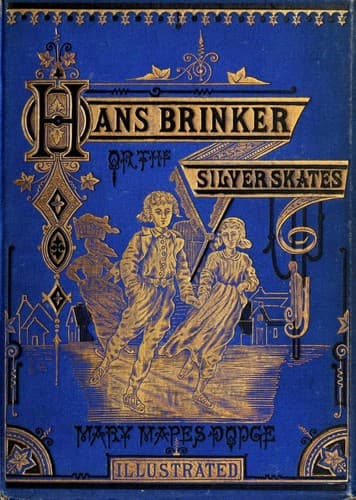
Hans Brinker; Or, The Silver SkatesDodge, Mary Mapes
History
Hans Brinker; Or, The Silver Skates
Dodge, Mary Mapes
Netherlands -- History -- 19th century -- Juvenile fiction; Siblings -- Juvenile fiction; Skating -- Juvenile fiction
This building, though plain outside for a palace, is elegantly furnished
within, and finely frescoed--that is, the walls and ceiling are covered
with groups and designs painted directly upon them while the plaster was
fresh. Some of the rooms are tapestried with Chinese silk, beautifully
embroidered. One contains a number of family portraits, among them a
group of royal children who in time were orphaned by a certain axe which
figures very frequently in European history. These children were painted
many times by the Dutch artist Van Dyck, who was court-painter to their
father, Charles the First of England. Beautiful children they were--what
a deal of trouble the English nation would have been spared, had they
been as perfect in heart and soul, as they were in form!
The park surrounding the palace is charming, especially in summer, for
flowers and birds make it bright as fairyland. Long rows of magnificent
oaks rear their proud heads, conscious that no profaning hand will ever
bring them low. In fact the Wood has for ages been held as an almost
sacred spot. Children are never allowed to meddle with its smallest
twig; the axe of the Woodman has never resounded there. Even war and
riot have passed it reverently, pausing for a moment in their
devastating way. Philip of Spain, while he ordered Dutchmen to be mowed
down by hundreds, issued a mandate that not a bough of the beautiful
Wood should be touched--and once when in a time of great necessity the
State was about to sacrifice it to assist in filling a nearly exhausted
treasury, the people rushed to the rescue, and nobly contributed the
required amount rather than that the Bosch should fall.
What wonder then that the oaks have a grand, fearless air? Birds from
all Holland have told them how, elsewhere, trees are cropped and bobbed
into shape--but _they_ are untouched. Year after year, they expand in
unclipped luxuriance and beauty; their wide-spreading foliage, alive
with song, casts a cool shade over lawn and pathway, or bows to its
image in the sunny ponds.
Meanwhile, as if to reward the citizens for allowing her to have her way
for once, Nature departs from the invariable level, wearing gracefully
the ornaments that have been reverently bestowed upon her--So the lawn
slopes in a velvety green; the paths wind in and out; flower-beds glow
and send forth perfume; and ponds and sky look at each other in mutual
admiration.
Even on that winter day the Bosch was beautiful. Its trees were bare,
but beneath them still lay the ponds, every ripple smoothed into glass.
The blue sky was bright overhead, and as it looked down through the
thicket of boughs, it saw another blue sky, not nearly so bright,
looking up from the dim thicket under the ice.
Public-domain text, read in full here on John Shaqi.
Reviews
Reviews
No reviews yet
Be the first to share your thoughts on this work.
Elsewhere in the archive
Join the Discussion
Join the discussion
Sign in to leave a comment or review.
Sign InorCreate an account