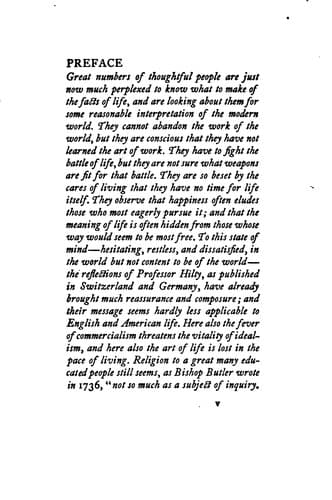
Happiness: Essays on the meaning of lifeHilty, Karl
Philosophy
Happiness: Essays on the meaning of life
Hilty, Karl
Conduct of life; Happiness
Here, also, in this free act of the will, is attained that sense of
liberty which in both the Old and New Testaments is described as
“righteousness.” It is a sense of initiative and power, as though one
were not wholly the subject of arbitrary grace, but had a certain
positive companionship with God. It is what the Old Testament calls a
“covenant,” involving mutual rights and obligations. No man, however,
who accepts this relation is inclined to urge overmuch his own rights,
knowing as he well does that his part in the covenant falls ever short
and is even then made possible only through his steady confidence in
God. Grace, unearned and undeserved, he still knows that he needs;
yet behind this grace lies ever the initiative of personal “turning,”
and the free assertion of the will as the first step toward complete
redemption. To say with Paul that a man is “justified by faith,” or to
emphasize as Luther does, even more strongly, the province of grace, is
to run some risk of forgetting the constant demand for an initial step
of one’s own.
This step once taken, both the world in which one lives and one’s own
personal life get a clear and intelligible meaning. On the one hand
stands the free will of God, creating and directing the world, not
restricted by the so-called laws of nature, yet a God of order, whose
desires are not arbitrary or lawless. On the other hand is the free
will of man, with the free choice before it of obedience or refusal;--a
will, therefore, which may choose the wrong though it may not thereby
thwart the Divine purpose. The evil-doer, if impenitent, must suffer,
but his evil is converted into good. In such a philosophy what is a
wisely adjusted human life? It is a life of free obedience to the
eternal and unchangeable laws of God; a life, therefore, which attains
through self-discipline successive steps of spiritual power. Life on
other terms brings on a progressive decline of spiritual power and with
this a sense of self-condemnation. What is the happy life? It is a life
of conscious harmony with this Divine order of the world, a sense,
that is to say, of God’s companionship. And wherein is the profoundest
unhappiness? It is in the sense of remoteness from God, issuing into
incurable restlessness of heart, and finally into incapacity to make
one’s life fruitful or effective.
Public-domain text, read in full here on John Shaqi.
Reviews
Reviews
No reviews yet
Be the first to share your thoughts on this work.
Elsewhere in the archive
Join the Discussion
Join the discussion
Sign in to leave a comment or review.
Sign InorCreate an account