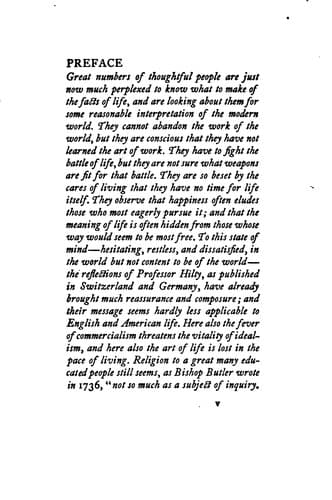
Happiness: Essays on the meaning of lifeHilty, Karl
Philosophy
Happiness: Essays on the meaning of life
Hilty, Karl
Conduct of life; Happiness
If, then, we are at times tempted to fancy that all this undemonstrable
experience is unreal, or metaphysical, or purposeless, or imaginary,
it is best to deal with such returning scepticism much as we deal with
the selfish or mean thoughts which we are trying to outgrow. Let all
these hindrances to the higher life be quietly but firmly repelled.
The better world we enter is indeed entered by faith and not by sight;
but this faith grows more confident and more supporting, until it is
like an inward faculty of sight itself. To substitute for this a world
of the outward senses is to find no meaning in life which can convey
confidence and peace. It is but to embitter every noble and thoughtful
nature with restless doubts from which there is no escape.
Such was religion as it disclosed itself to the early Hebrews. Soon,
indeed, that religion was overgrown by the formalism which converted
its practical teaching into mere prohibitions or mere mechanism; but
behind these abuses of later history lay the primitive simplicity of
spiritual liberty and life. Such also was the historical beginning
of the Christian religion. The mission of Christ, like that of each
genuine reformer, was to recall men to their original consciousness
of God; and it is perhaps the greatest tragedy of history, while at
the same time the best proof of the free will of man, that the Hebrew
people, to whom Christ announced that he was expressly sent, could
not, as a whole, bring themselves to obey his call. They were held in
bondage by their accumulated formalism, as many a man has been ever
since. They could not rise to the thought of a worship which was in
spirit and in truth. Had they, with their extraordinary gifts, been
able to hear Christ’s message, they would have become the dominant
nation of the world.
And what is to be said of those Gentile peoples who listened more
willingly to the message of Christ, those “wild olive trees,” as St.
Paul calls them, which were grafted on the “broken branches”? They also
have had the same history. They also, in their own way, have become
enslaved by the same formalism; and they also must regain their liberty
through the return of individual souls to a personal experience of the
method of Christ.
Public-domain text, read in full here on John Shaqi.
Reviews
Reviews
No reviews yet
Be the first to share your thoughts on this work.
Elsewhere in the archive
Join the Discussion
Join the discussion
Sign in to leave a comment or review.
Sign InorCreate an account