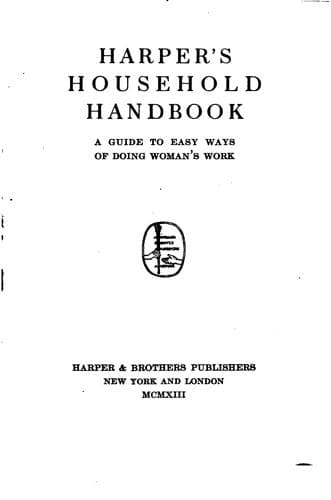
Harper's Household Handbook: A guide to easy ways of doing woman's workMcCulloch-Williams, Martha
General
Harper's Household Handbook: A guide to easy ways of doing woman's work
McCulloch-Williams, Martha
Formulas, recipes, etc.; Home economics
FOOD: CHOOSING AND KEEPING
=Flour=: Perfect flour has a slight yellow tinge and a faint, pleasant
smell, especially after wetting. Dazzling whiteness indicates bleaching;
a gray tinge or minute black specks, showing only under the microscope,
grinding from spoiled grain. Test by gripping a handful—if it remains
the shape of the hand and shows the lines of the palm, buy it. Gluten is
a most desirable element. Test for it by wetting a pinch to a stiff
dough, and washing the starch out of it in cold water. The greater and
tougher the stringy residue the greater the gluten content. Wet another
pinch very soft, take it betwixt thumb and finger, and try to spin a
thread. If it spins, all well; if it does not, but makes only blobs on
the finger tips, there is likely to have been corn ground with the
wheat. Another test for corn admixture is to dry a pinch, but not scorch
it, and rub between the finger tips. Pure wheat flour will not feel
gritty, but corn, no matter how finely ground, remains a little rough.
Set flour barrels a little above the floor, and do not use the same one
continuously. Any wooden container may become a harbor for insects. A
japanned tin can, emptied and aired monthly, is best for keeping flour,
meal, or oatmeal in bulk. All should be kept where it is dry, airy, and
free of smells, as all take up taints very readily.
=Cornmeal=: Fresh water-ground cornmeal has a pleasant smell, and runs
through the fingers without caking or clotting. A musty odor shows it is
too old. Meal from white flint corn is much the most desirable. Sift it
at need—the bran helps to keep it. Cornmeal kiln-dried and bolted, as it
has to be for the grocers to save it from spoiling, is, in a sort a
libel on the real thing. In it there is not much choice save between
fine and coarse grinding. Fine-ground makes clammy bread, hence is to be
avoided. But even kiln-drying should not quite take away the original
fragrance. Perfect meal shows under the microscope round white grains
like fairy hail.
=Oatmeal=: Beware that which has much grain dust between the grains.
Examine carefully a double handful before buying in quantity; if you
find even one trace of weevil, reject it. Weevil and sundry
mites—_Acari_ in scientific parlance—are the bane of grain foods if they
are kept over long. Hence the caution of keeping them in bright metal
away from dampness and molds.
=Buckwheat Flour=: Fresh buckwheat flour is of a slightly tawny cast and
a lively velvet feel. Mustiness means age—at first there is hardly any
smell. Clotting or caking indicates dampness either of grain or storage,
hence a product below grade.
=Grits and Hominy=: Judge by the absence of grain dust and the even
grinding; grains the same size approximately cook evenly. Examine a
sprinkle through a magnifying-glass, and if there are signs of weevil or
mites do not buy at any price. A pocket magnifier is cheap and handy,
also it may save you many times its cost in a single month.
Public-domain text, read in full here on John Shaqi.
Reviews
Reviews
No reviews yet
Be the first to share your thoughts on this work.
Elsewhere in the archive
Join the Discussion
Join the discussion
Sign in to leave a comment or review.
Sign InorCreate an account