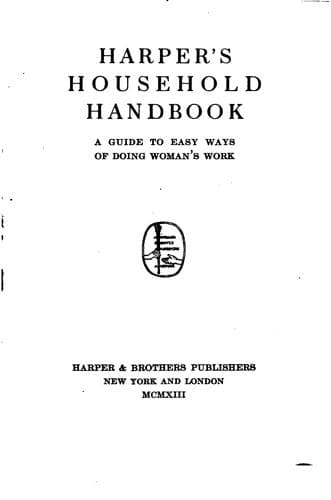
Harper's Household Handbook: A guide to easy ways of doing woman's workMcCulloch-Williams, Martha
General
Harper's Household Handbook: A guide to easy ways of doing woman's work
McCulloch-Williams, Martha
Formulas, recipes, etc.; Home economics
=Coffee=: Green coffee beans break with a clean fracture, and if the
break is ragged or spongy there has been mold or heating. Roasted beans
should show one-half very dark brown, the other half black but not
scorched. Crack between the teeth; you can taste scorching. Fresh-ground
coffee is stronger and more flavorous than that ground in bulk. Also
there is less chance of adulteration. To test for adulteration, stir a
pinch of ground coffee into a glass of cold water. Pure coffee settles
to the bottom, leaving hardly a trace of color. Chicory will rise to the
top, also making a kind of scum. Adulteration with roasted grain or
bread or the artificial beans will color the water more or less deeply.
Keep coffee in bright tin or glass, tightly closed, away from light,
where it is dry and cool.
=Tea=: Tea is largely a matter of taste and brands, also prices. Very
cheap tea is undesirable, being commonly adulterated with spent tea
leaves. Tests vary as much as brands. A safe and easy one is to infuse a
pinch of tea one minute in boiling water, pour off one-half, and let the
other half stand, keeping at almost boiling heat for ten minutes. Pour
off and compare in smell and taste with the first. Artificial color, if
present, will show as dregs in the long steeping and reveal itself
further in a faint metallic taste. Various copper salts are the
commonest coloring matters, and, though the quantities are too small to
be immediately dangerous, constant use may develop stomach trouble. Tea
is best kept air-tight, dark, dry, and warm.
=Butter=: Beware butter too yellow, especially if winter-packed. Butter
colors are harmless in the main, but some constitutions are intolerant
of them. Look for firm texture slightly grained and a lively, agreeable
smell. A sour smell and white specks show something to let alone. Keep
tightly covered, dark, and cool, away from any possibility of taints.
=Lard=: If you do not know, experimentally, good fresh lard, get leaf
fat, try it out, taking care not to scorch it, and use the product as a
standard. Lard must be firm, but not hard, even-textured throughout, and
with almost no smell. Your nose, if permitted, will tell you if it is
either scorched or rancid—the two unpardonable faults. From grain-fed
pork it is clear white, with now and then a faint cream tinge. Keep in
glass or bright tin, tightly closed, where it is cool and dark.
Public-domain text, read in full here on John Shaqi.
Reviews
Reviews
No reviews yet
Be the first to share your thoughts on this work.
Elsewhere in the archive
Join the Discussion
Join the discussion
Sign in to leave a comment or review.
Sign InorCreate an account