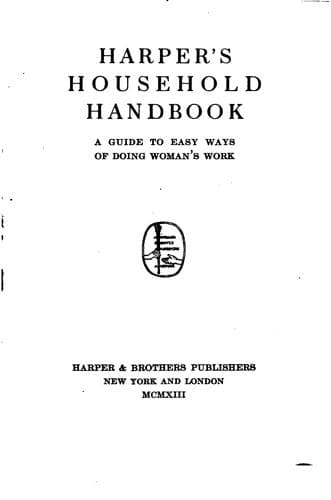
Harper's Household Handbook: A guide to easy ways of doing woman's workMcCulloch-Williams, Martha
General
Harper's Household Handbook: A guide to easy ways of doing woman's work
McCulloch-Williams, Martha
Formulas, recipes, etc.; Home economics
=Potting=: Pots must be proportioned to their contents. A hyacinth bulb
will thrive in a four-inch pot. A clump of three will grow in a six-inch
one; it should be shallow. A shallow eight-inch pot will hold a dozen
tulips or Roman hyacinths or two dozen crocuses. Broad pots, rather
shallow, are best for all manner of bulbs save the tall-growing lilies,
such as the Amaryllis family, Auratum, and Easter lilies. Plant rooted
cuttings in two-inch pots, shifting them as they grow. Over-potting is a
drawback, especially with flowering things. Do not shift until the pot
is filled with roots—test for that by turning out—and shift to the next
size. Seasonal bulbs rarely require shifting, but those kept year in and
out must be separated from their offsets and given fresh earth. In
shifting put an inch of broken pot in first, arranging a big bit over
the hole, fill in a little earth, then set the plant upon it; the ball
at its root should come within an inch of the top. Hold it plumb and
fill in sifted earth about it, shaking the pot gently after each
handful. Shake hard when the pot is full; fill in chinks around the edge
and put a little fresh earth on top, then water freely but without
splashing. Let it drain and set in place. Always have something
underneath to catch the drip. Glazed ware is better than the clay
saucers—they make damp spots.
Plant bulbs their own depth in earth except the finer lilies. Set them
only a little way in earth. It is safer to make a little hole in the
earth, put in a handful of clean sand, and bed the bulb in the sand.
Keep very wet—sand will not rot the bulb surface. Fill up with soil an
inch higher, but keep it away from the bulb with a sand blanket, and put
a very thin layer of sand on top. Plant ordinary bulbs in succession
from September to December, keep damp and dark for some weeks to insure
root growth, then bring to light, water, and fertilize, turning every
three days to make symmetrical.
=Plant Choice=: No plant will live long without light—few will thrive
without more or less sunlight. The green-and-white Aspidastra is the
hardiest in this respect. Plants used for interior decoration must be
often shifted, set in light, fertilized, and bathed till thrifty, while
others in good condition take their places. Weekly changes will maintain
a proper effect. Palms and ferns are most satisfactory for such uses;
flowering things get ragged very quickly. Begonias carefully tended and
not allowed to dry out nor get hot make a brave showing. So do
wax-leafed woody things—dwarf orange and lemon trees, rubber trees,
dwarf evergreens and box trees.
=Plants for a North Light=: Fuschia stands pre-eminent, next to that
thrifty ferns, ivy of both sorts, dwarf evergreens, spiderwort,
moneywort, and trailing box vine. An hour or two of sunlight will
suffice for all these, other conditions to their mind; also, in their
season, for pansies, violets, and the dwarf Japanese morning glories so
wonderful in color and texture.
Public-domain text, read in full here on John Shaqi.
Reviews
Reviews
No reviews yet
Be the first to share your thoughts on this work.
Elsewhere in the archive
Join the Discussion
Join the discussion
Sign in to leave a comment or review.
Sign InorCreate an account