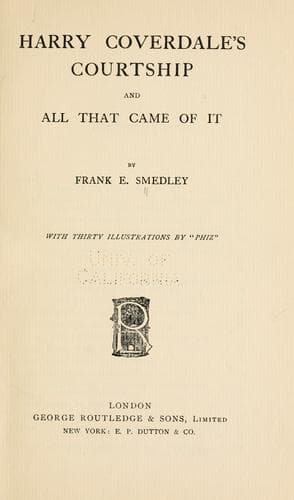
Harry Coverdale's Courtship, and All That Came of ItSmedley, Frank E. (Frank Edward)
General
Harry Coverdale's Courtship, and All That Came of It
Smedley, Frank E. (Frank Edward)
England -- Social life and customs -- 19th century -- Fiction; English fiction -- 19th century
English, checked the flow of her eloquence by exclaiming abruptly and
cheerfully, “Yes, dear, certainly--but don’t say another word about it;
we were both very silly, and made each other very miserable, when we
might be as happy as the day is long; let bygones be bygones, we will
forgive and forget, and be wiser for the future, eh?” As he spoke, he
drew her to him, and sealing his forgiveness on her lips with a kiss,
rendered all discussion impossible by leaving the room.
This speech (kiss included) ought to have satisfied any reasonable wife,
but unfortunately at that moment Alice was not exactly in a reasonable
frame of mind; she had dwelt so long on one idea, in accordance with
which she had arranged the whole programme of a dramatic reconciliation
scene, that she by no means approved of Harry’s short cut to concord,
rendering null and void all her explanation of how, and why, and
wherefore she had come to behave ill, together with a spirited sketch in
monologue of her contrition for the past and vows of amendment for the
future; the whole to conclude with certain annotations and reflections,
which she trusted would so affect her husband’s feelings, and convince
his understanding, that he would for the future restrict shooting to two
short mornings a-week, and cast hunting “to the dogs” entirely, and now
all the mysterious pleasure the gentler sex derive from talking a thing
_well_ over, was denied her.
Ah! that “talking over,” what a wonderful female attribute it is! how
vast and important a part of “woman’s mission” does it constitute!
in fact, we have met innumerable women--the majority of our female
acquaintance, we should say--whose whole and entire mission appears to
consist of a “call” to “talk over,” first, their neighbours’ affairs (a
duty to their neighbour in which they never fail), secondly, their own.
The French aphorism (seldom acted upon, by its voluble originators),
_Cela va sans dire_, must seem unspeakably absurd to these advocates for
an indefinite extension of the “freedom of debate;” while the “silent
system” must appear a more “capital punishment” than death itself,
always supposing the excellence of a punishment to be tested by its
severity: but we are slightly digressing.
Public-domain text, read in full here on John Shaqi.
Reviews
Reviews
No reviews yet
Be the first to share your thoughts on this work.
Elsewhere in the archive
Join the Discussion
Join the discussion
Sign in to leave a comment or review.
Sign InorCreate an account