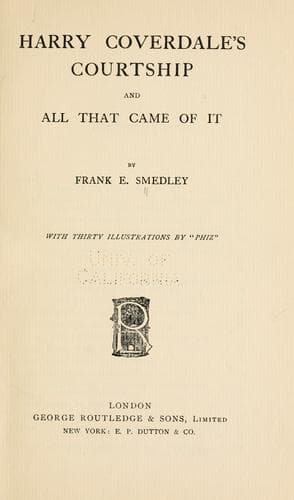
Harry Coverdale's Courtship, and All That Came of ItSmedley, Frank E. (Frank Edward)
General
Harry Coverdale's Courtship, and All That Came of It
Smedley, Frank E. (Frank Edward)
England -- Social life and customs -- 19th century -- Fiction; English fiction -- 19th century
“An admirable reason for shaking hands with an individual who has
knocked you down,” returned Coverdale, “but none whatsoever for
screening two malefactors from the just punishment of their ill-deeds;”
then, lapsing into the magistrate, he continued, “You mistake the whole
scope and intention of our penal code, my dear Alice. We do not punish
offenders as an act of revenge upon the individual, but in order to
benefit society by deterring others from committing a like crime;
thus, laying aside personal feeling, I should be doing an injury to the
community at large, by refusing to prosecute these fellows. You see this
clearly, do you not?”
Alice’s reasoning powers did see it, and had seen it all along, but
Alice had also seen the poor wife and the meritorious and seductive
baby, and she cared “fifty thousand times” (as she herself would have
expressed it) more for them than for the community at large; so finding
that the argument was going against her, she, woman-like, adroitly
shifted her ground. “According to your reasoning, there would be no
room for such a quality as mercy,” she began; “stern, inexorable justice
would condemn every criminal, no matter what extenuating circumstances
there might be; in each case punishment must follow sin, as effect
follows cause. I, for one, should be very sorry always to be judged by
such a cruel rule.”
“Oh, if you’re going to put German metaphysical sophistries in the place
of English common-sense, I’ve no more to say about it,” returned Harry,
gruffly; “only it seems to my simplicity that punishment always does
follow crime in this world, as soon as it’s found out. If a brat steals
the sugar, its mother slaps it; if a schoolboy prigs apples, the master
flogs him; if an apprentice bolts with the till, the law transports him;
if Jack murders Tom, the hangman stretches his neck for him:--and serve
’em all right say I; it would be a precious deal worse world to live
in if it were not so, to my thinking.”
Alice paused to consider the justice of this remark--we will follow her
example!
CHAPTER XXIX.--HOW TO MAKE HOME HAPPY.
Mrs. Coverdale, resuming the matrimonial discussion broken off at the
end of the last chapter, thus pursued the argument by which she hoped to
induce her husband to let off her poaching _protégé._
“In the present case the innocent must suffer with the guilty. I see no
justice in ruining a poor family by imprisoning or transporting the only
member who is able to work and support it.”
Public-domain text, read in full here on John Shaqi.
Reviews
Reviews
No reviews yet
Be the first to share your thoughts on this work.
Elsewhere in the archive
Join the Discussion
Join the discussion
Sign in to leave a comment or review.
Sign InorCreate an account