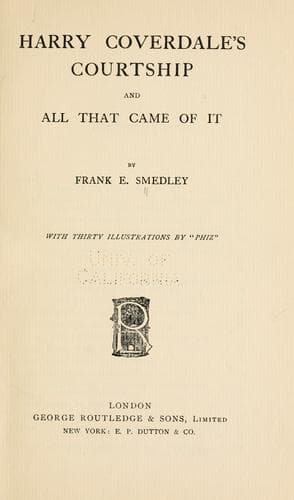
Harry Coverdale's Courtship, and All That Came of ItSmedley, Frank E. (Frank Edward)
General
Harry Coverdale's Courtship, and All That Came of It
Smedley, Frank E. (Frank Edward)
England -- Social life and customs -- 19th century -- Fiction; English fiction -- 19th century
“Alice, you are changed,” exclaimed Arthur, as the door closed on her
whom he had once so deeply loved, towards whom he now felt as we can
only feel towards those whom we have admitted into the inmost recesses
of the heart, and who have availed themselves of the privilege to
profane and make desolate the sanctuary, “you were a girl, you have
become a woman; has matrimony produced the alteration?”
“Yes, I suppose so,” was the rejoinder. “You know one can’t remain a
child always; the realities of life are sure to find one out sooner or
later, and I was a mere baby in the ways of the world when I married.”
There was a spice of regret in the tone of this remark, which did not
escape Arthur’s quick ear and keen intelligence, and he hastened to
reply--
“You mean more than you say; why, surely, Alice, with such a husband you
must be perfectly happy; it is impossible that it can be otherwise.”
As he spoke, he fixed his dark eyes questioningly upon her. Unable
fairly to meet his gaze, Alice turned away her head, as she replied,
with an effort at careless gaiety--
“Don’t alarm yourself, most romantic of barristers; there is no
Bluebeard’s closet at Coverdale, nor does Harry turn into a skeleton,
or anything else but his bed, at twelve o’clock at night. He is just the
thoroughly good fellow (that is the term you men delight in) he always
was, and devoted to----
“His wife!” interrupted Arthur.
“Well, I was going to say dogs, guns, and horses,” returned
Alice; “and I’m afraid I must adhere to my text, unless you prefer
fiction to fact.”
She spoke jestingly; but the lines which care, and thought, and
intellectual exertion had already traced on Arthur’s brow deepened, as,
after a pause, he murmured, half in reply to Alice, half in soliloquy--
“I am disappointed, deeply disappointed; it ought to be so different!
I--I wish I were not going abroad to-morrow; and yet I _could_ not be a
frequent visitor in this house!”
The last words were inaudible, though, by one of those intuitions which
often compensate for the inefficiency of our physical powers, Alice
divined his train of reasoning, and with subtle generalship diverted the
attack, by carrying the war into the enemy’s country, as she replied--
“Do not puzzle your brains about me and Harry; we jog on very serenely
together, now we have found out each other’s peculiarities.”
“But you never _had_ any peculiarities, either of you,” interrupted
Arthur, positively; “except that Harry was the finest, noblest, manliest
fellow going, and you were a good, simple-hearted, sweet-tempered little
girl. What do you mean by peculiarities?”
“Never mind us,” continued Alice, not heeding his interruption; “I want
to know something about you. You say I have changed from a child into
a woman, but you have turned from a young man into a middle-aged one
during these last six months; you are either ill or unhappy, or working
yourself to death--all three, perhaps.”
Public-domain text, read in full here on John Shaqi.
Reviews
Reviews
No reviews yet
Be the first to share your thoughts on this work.
Elsewhere in the archive
Join the Discussion
Join the discussion
Sign in to leave a comment or review.
Sign InorCreate an account