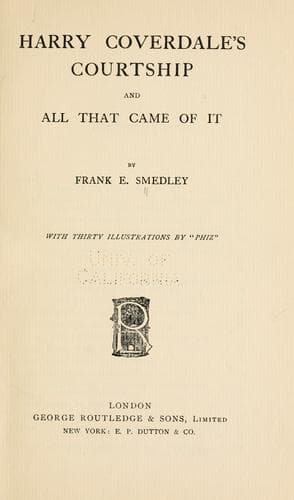
Harry Coverdale's Courtship, and All That Came of ItSmedley, Frank E. (Frank Edward)
General
Harry Coverdale's Courtship, and All That Came of It
Smedley, Frank E. (Frank Edward)
England -- Social life and customs -- 19th century -- Fiction; English fiction -- 19th century
Arabella Crofton was a handsome woman of thirty, looking younger than
her age. She was tall, and her figure was fully developed without being
actually _embonpoint_. Her hands and feet, although proportioned to her
height, were beautifully modelled, and the former unusually white and
soft. In feature she resembled Kate, so much so that she had more
than once been mistaken for her former pupil’s elder sister; but the
_expression_ of the two faces was totally dissimilar. In Kate Crane
a fiery passionate nature was kept under control by an equally strong
degree of pride, and an amount of self-respect which served her in place
of a higher principle; in Arabella Crofton lay concealed even a greater
depth of passion, but its sole antagonist was an intellect keen, strong,
and acute, though not of the highest order, and a determination of
will and fixity of purpose which, while it led her straight towards the
object she sought, rendered her somewhat unscrupulous as to the means by
which it was to be attained; and as the mind usually writes itself more
or less legibly on the countenance, so did the expression differ in Kate
and her late governess. Still Miss Crofton’s was a face to attract and
rivet attention, a face which exercised a species of fascination over
those who beheld it, so peculiar that it is not easy to define it.
As you gazed upon it, you felt that you were in the presence of an
intelligence of no common order, but of whose nature, hopes, fears,
wishes, and designs, you were entirely ignorant--nay, in regard to which
you could not decide whether the good or evil principle predominated. In
this sense of power with which she impressed others, together with the
uncertainty how it might be directed, lay the secret of much of Arabella
Crofton’e influence. Alice, not being metaphysical, did not attempt to
define the sensations with which her new acquaintance inspired her; had
she done so, it might have appeared that she had formed much the
same estimate of her manner and appearance as that with which we have
furnished the reader. But if Alice did not moralize, she arrived at
strong and definite conclusions without that process, for before she had
been half an hour in Miss Crofton’s company, she felt morally
convinced that she should hate her, and that it would turn out that the
_ci-devant_ governess either had done, or was about to do, something
which would completely account for and justify this sudden animosity.
During dinner, a note arrived from Lord Alfred Courtland, offering
Alice and Harry seats in his opera-box, which offer, after a few polite
speeches to and from Mr. Crane, in his (in?) capacity as master of
the house, was accepted. As they drove to the theatre, the following
conversation passed between the husband and wife, the lady of course
beginning it.
Public-domain text, read in full here on John Shaqi.
Reviews
Reviews
No reviews yet
Be the first to share your thoughts on this work.
Elsewhere in the archive
Join the Discussion
Join the discussion
Sign in to leave a comment or review.
Sign InorCreate an account