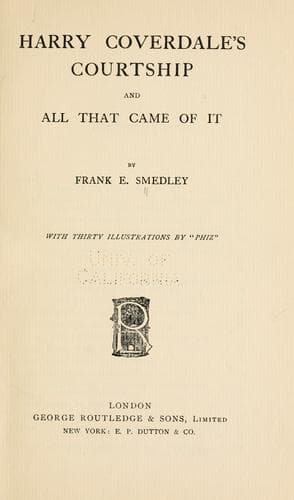
Harry Coverdale's Courtship, and All That Came of ItSmedley, Frank E. (Frank Edward)
General
Harry Coverdale's Courtship, and All That Came of It
Smedley, Frank E. (Frank Edward)
England -- Social life and customs -- 19th century -- Fiction; English fiction -- 19th century
with a sort of washy sentimentality, which enabled him to pass as an
individual of refined tastes and cultivated mind with those who did not
look beyond the surface; personally he rejoiced in a complexion as of
bad putty, and an amount of heroic beard and moustaches which would have
stuffed a chair-cushion very comfortably. And being such as we have
described him, Herr Hildebrand--an acquaintance of and introduced by
Horace D’Almayne, who, in his multifarious occupations, may have been a
banded-brother, for aught we know to the contrary--had suggested to Lord
Alfred Courtland the great advantage it would be to him in his, the
professor’s, talented absence, if he, Lord Alfred, could find any
amiable pianiste of his acquaintance, able and willing to play duets
with him, to “improve his time;” and as he said this in the presence of
and immediately after a _tête-à-tête_ with Horace D’Almayne, it really
was scarcely necessary for that judicious mentor to suggest to his
lordship pretty little Mrs. Coverdale, although to guard against
mistakes he did so. Thus Alfred Courtland and Alice had played a good
many duets in Park Lane; and on the morning in question, luncheon being
announced in the middle of one of these interesting performances half an
hour sooner than usual, to guard against the possibility of anybody’s
being too late, Alice, feeling by this time quite at home in her
cousin’s house, coolly told Lord Alfred to come down and partake of the
mid-day meal, as she was resolved to finish the duet after it was over,
before she went to dress, and if they made haste she was sure there was
plenty of time. But time unfortunately is one of those stubborn facts
with which it is impossible to take a liberty without suffering for
one’s rashness; and although the latter part of the duet was rattled
through with a Costa-like rapidity, which elicited from his breathless
lordship an acknowledgment that “it is the pace that kills,” yet when
all the rest of the party were assembled, Alice was only half dressed.
Then, as was his wont on such occasions, Mr. Crane fell into a fretful
fuss, and trotted up and down the room, and made everybody fidgety and
uncomfortable, especially Harry, who was provoked with Mr. Crane for
being annoyed with Alice, and with Alice for having given him cause for
annoyance.
“There is a quiet way of arranging the matter, my dear sir,” he said;
“let those who are ready start in the barouche, and I will wait and
drive Alice in the mail-phaeton.”
Public-domain text, read in full here on John Shaqi.
Reviews
Reviews
No reviews yet
Be the first to share your thoughts on this work.
Elsewhere in the archive
Join the Discussion
Join the discussion
Sign in to leave a comment or review.
Sign InorCreate an account