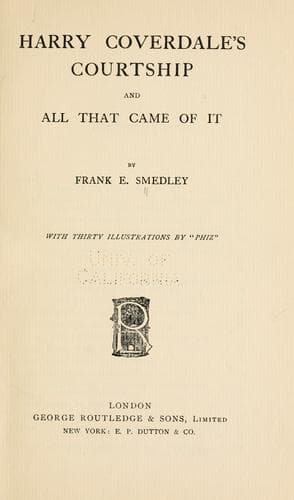
Harry Coverdale's Courtship, and All That Came of ItSmedley, Frank E. (Frank Edward)
General
Harry Coverdale's Courtship, and All That Came of It
Smedley, Frank E. (Frank Edward)
England -- Social life and customs -- 19th century -- Fiction; English fiction -- 19th century
“Do not think of such a thing!” exclaimed Arabella, hastily; “it was
folly in me to mention it:”--she fixed her eyes on his face, and reading
there that his resolution was unchanged, she laid her hand gently on his
arm, and continued. “Listen, and I will tell you the whole truth: womanly
instinct, I suppose, made your wife dislike me from the first moment she
was introduced to me. I have tried in vain to conquer her dislike,
and we now, by a sort of tacit consent, avoid each other; were you to
interfere in my behalf, it would be of no avail; on the contrary,
it would increase the evil, and, pardon my saying, might lead to a
disagreement between you; for, I may be mistaken, but I have fancied
Mrs. Coverdale appears a little impatient of control sometimes--I hope I
am mistaken.”
She waited for a reply; but Harry, not being able to deny the charge,
and not choosing to assent to it, remained silent, and she, rightly
interpreting his reserve, continued:--
“In that case, I implore you, do not dream of advocating my cause. Were
I to be the occasion of any difference between you, it would render me
most unhappy.”
After a moment’s silence, she added--
“I was so much interested when I heard you were going to be married, and
hoped, nay prayed, that you might be as happy as I would--would always
have you. I am grieved to think that Mrs. Coverdale should not fully
appreciate the prize she has drawn in that most uncertain of all
lotteries, marriage; but I feel sure she will learn to understand you
better, and all will come right: you are evidently much attached to her,
and that being the case, she _must_ love you.” Then in a lower tone she
added--“_You_ are not one likely to love in vain.”
What reply, if any, Harry would have made to this speech, will never be
known, as at that minute they entered the line of carriages setting down
at the gate of the Chiswick Gardens, and Coverdale had enough to occupy
him in preventing his excitable horses from committing a breach of the
peace. Whether or no the phaeton groom was an observant man we cannot
say, but if he felt the degree of amiable interest usually displayed by
domestic servants in the affairs of their superiors, he must have been
struck when mentally contrasting Mr. Coverdale’s manner of handing Miss
Crofton into and out of that open carriage by an immense accession of
cordiality, for which he was probably more puzzled to account than we
trust the reader finds himself.
CHAPTER XXXV.--FLOWERS AND THORNS.
“We have somehow contrived to lose sight of the barouche,” exclaimed
Coverdale, after looking up and down the line of carriages in vain; “I
expect they must have escaped us when that white-nosed horse shyed at
Punch; I fancied I knew which way they had turned, but I must have gone
down a wrong street--poor old Crane will be in fits--I wonder what we
had better do?”
Public-domain text, read in full here on John Shaqi.
Reviews
Reviews
No reviews yet
Be the first to share your thoughts on this work.
Elsewhere in the archive
Join the Discussion
Join the discussion
Sign in to leave a comment or review.
Sign InorCreate an account