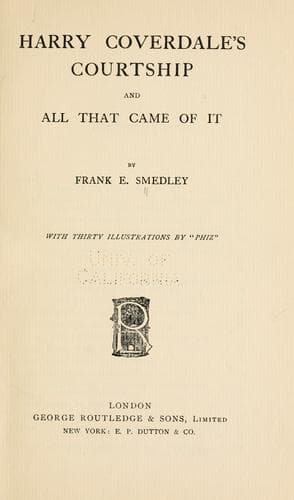
Harry Coverdale's Courtship, and All That Came of ItSmedley, Frank E. (Frank Edward)
General
Harry Coverdale's Courtship, and All That Came of It
Smedley, Frank E. (Frank Edward)
England -- Social life and customs -- 19th century -- Fiction; English fiction -- 19th century
For some time, little Mrs. Coverdale was sufficiently amused by
observing the appearance, manners, and customs of the various
notabilities, as they were pointed out to her by no less a personage
than her hostess, who, attracted by the simple beauty of her new
acquaintance, and the evident pleasure and interest she took in all
that was going on around her, actually devoted to her ten minutes of
the valuable time in which, on such occasions, a clever mistress of the
house is expected, and actually contrives, to say and do something
civil to an hundred and fifty human beings, all prepared to magnify
any accidental neglect into an intended slight, and to resent it
accordingly. But, ere ten minutes had well elapsed, an illustrious
stranger arrived, who was so intensely foreign that he could not be
prevailed upon to speak or understand any language of which the deepest
philologists present were able to make head or tail, and who, in his
consequent bewilderment, had seated himself on the music-stool, with
his back towards the key-board of the pianoforte--thereby establishing a
complete blockade of that harmonious and indispensable instrument, which
no representations in French, German, or Italian, could induce him to
relinquish: so a breathless female aide-de-camp, in flaxen ringlets
and white muslin, hurried up to report this frightful dilemma to
the commandress-in-chief, who, with the greatest presence of mind,
dispatched her to summon Count Cacklewitz, the young Hungarian patriot,
who, it was generally believed, could speak everything, even his
own language, and then hastened in person to raise the siege of the
piano-forte. Alice, thus deserted, fell into the hands of a tall, gaunt,
blue woman, rejoicing in a red nose and a long fluent tongue, who began
to talk high art to her, and confused her about transcendentalism and
Carlyle,--_the_ Oxford Graduate (viz., Turner’s single and singular
disciple, wonderful Mr. Buskin), and pre-Raphaelism,--the meaning of
Tennyson, when he condescends to be obscure (for he _can_ write real
poetry, which “he who runs may read” and feel),--and of the dark
Brownings, and Macaulay and the romance of history, and many other
hackneyed pseudo-literary topics of the day, until our unlucky little
heroine lapsed into that state of mental incapacity usually described as
not knowing whether one is standing on one’s head or one’s heels. Then
began vocal music, which mercifully silenced Alice’s strong-minded
persecutor; and a rather raffish baritone gentleman, who wanted shearing
dreadfully, and was all voice, eyes, and feathers, like a lean bird,
accosted a singularly hard-featured, middle-aged German lady, as “Oh!
thou beloved one!” to which she made an appropriately tender _soprano_
reply; and the company listened with much forbearance, for quite ten
minutes, to the united affections of this interesting couple, detailed
to an accompaniment now rapturous, now pathetic, at the end of which
Public-domain text, read in full here on John Shaqi.
Reviews
Reviews
No reviews yet
Be the first to share your thoughts on this work.
Elsewhere in the archive
Join the Discussion
Join the discussion
Sign in to leave a comment or review.
Sign InorCreate an account