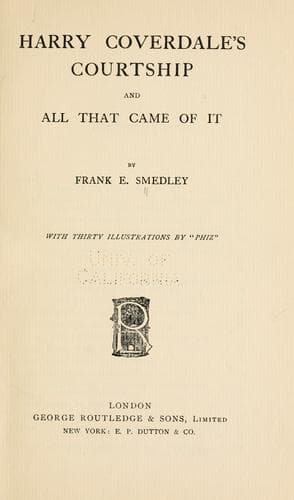
Harry Coverdale's Courtship, and All That Came of ItSmedley, Frank E. (Frank Edward)
General
Harry Coverdale's Courtship, and All That Came of It
Smedley, Frank E. (Frank Edward)
England -- Social life and customs -- 19th century -- Fiction; English fiction -- 19th century
“Ungrateful! when it was for your interest I was exerting myself,”
returned D’Almayne, reproachfully; “but you do not explain why you have
quitted _la belle_ Alice; you really are not sufficiently attentive; no
pretty woman likes to be neglected.”
“She’s a little fickle, heartless coquette, and I’ll let her see that
I’m not so completely her slave as she appears to imagine,” answered
Lord Alfred, snappishly, at the same time filling his glass with
Champagne; “she refused to dance with me more than twice because it
was not _étiquette_, and she wished to be extra particular because
her husband was not here. I don’t think he’d overwhelm her with his
attentions if he were, unless he means to alter very much. No: the fact
is, she is out of humour, and chooses to vent it on me; it would just
serve her right if I were to go home, and leave her to her own devices.”
“Do nothing of the kind, _mon cher_; but listen to me, and--excuse me,
but don’t drink any more Champagne, or you’ll do something absurd; your
comic friend brewed that Sherry-cobbler too strong. Go quietly back to
the Coverdale; try and persuade her to dance, but if she refuses,
show no annoyance, and get her to allude again to her husband: then
carelessly and incidentally, as if you had no design in what you were
saying, suggest that she would scarcely be so particular, if she
knew what a naughty boy he had been in Italy, and having excited her
curiosity, tell her the following little anecdote.”
As a bevy of men entered the refreshment-room at that moment, D’Almayne,
linking his arm with that of Lord Alfred, led him aside, and made to him
a communication, the nature of which will appear in the due course of
this history. Lord Alfred seemed surprised, and, to his credit be it
spoken, even pained, by the information thus afforded him; and when
D’Almayne had concluded, his auditor remained a minute or so buried in
thought, then he asked abruptly--
“You are _sure_ there is still some clandestine understanding between
them--you are quite certain?”
“I am as certain as a man can be of any clandestine proceeding to which
he is not a party,” was the reply; “you are aware of what I observed
on the occasion of the Horticultural Fête. I now relate to you the
antecedents; you are no longer a child, but sufficiently a man of the
world to draw your own deductions.” The adroit flattery on the weak
point told: faith in truth and honour would argue a want of knowledge of
life; so with a slight laugh, assumptive of an omniscience in evil, he
replied, “I was willing to give him the benefit of a doubt, if it were
possible; but, as you say, the thing is clear enough; and now, how is
this to advantage me?”
“Do you ask?” was the surprised rejoinder; “I thought you told me just
now that the cruel fair one had snubbed you, by throwing her duty to
her husband at your head; so it occurred to my simplicity that this
information, properly applied, would prevent a recurrence of such
rebuff.”
Public-domain text, read in full here on John Shaqi.
Reviews
Reviews
No reviews yet
Be the first to share your thoughts on this work.
Elsewhere in the archive
Join the Discussion
Join the discussion
Sign in to leave a comment or review.
Sign InorCreate an account