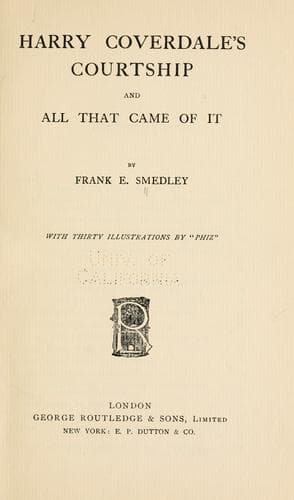
Harry Coverdale's Courtship, and All That Came of ItSmedley, Frank E. (Frank Edward)
General
Harry Coverdale's Courtship, and All That Came of It
Smedley, Frank E. (Frank Edward)
England -- Social life and customs -- 19th century -- Fiction; English fiction -- 19th century
One, who saw all clearly where we but blindly and feebly catch a ray of
light, prayed for His executioners in these remarkable words--“Father,
forgive them, _they know not what they do!_” Ideas such as the foregoing
are calculated to inspire feelings of awe; but, if they are true,
they should not be put aside because they give a solemn view of our
responsibilities; when, moreover, rightly considered, they teach an
important practical lesson--namely, never to neglect what appear to be
little duties, or carelessly to fall into little sins. It seems but a
little duty to extinguish a fallen spark; yet that spark may kindle a
fire which may consume a city, which, save for that accident, might have
endured for centuries. It seems but a little sin to utter a playful jest
on some serious subject; but that jest may inspire a doubt which may
injure a wavering faith, and endanger a soul’s salvation. Some may deem
these remarks misplaced in a work of fiction; but if it be a novelist’s
endeavour to depict truly the various phases of human life, nought that
truly affects the springs of human action can be foreign to his subject.
The evening of Lady Tattersall Trottemout’s party was not the first
occasion on which Harry Coverdale had bestowed good and sound advice on
Arabella Crawford, but never before had it produced the desired effect.
Now, however, a new impulse sprang up within her--she would conquer her
hopeless, selfish, sinful love for him, and strive to render herself
worthy of his friendship, and win at least his esteem; but how should
she begin practically to work out his advice--how attempt to render
herself independent--what duty lay most directly in her path? Her
intention was honest and sincere, and that morning’s post brought
an answer to her question. A female relation whom she had hitherto
neglected, was taken seriously ill, and wrote wishing, but scarcely
expecting, her to come to her immediately. This lady was old,
uninteresting, and in straitened circumstances; to go to her was an act
of unmitigated self-sacrifice, and in Arabella’s then frame of mind
this was its great attraction. Kate Crane was sorry to part with
her, although the short time they had passed together had sufficed to
convince her of the disagreeable fact that her dear friend no longer
suited her as she had done in her schoolgirl days. There was a very
simple reason for this, although Kate did not at once perceive it:
Arabella Crofton was at an age when the mind and body having reached
maturity, if they do not remain stationary, yet alter so gradually, that
the change is almost imperceptible; she was, therefore, much what she
had been four years previously. Kate, on the contrary, had advanced from
a girl into a woman; and her intellectual powers had not only
developed until they were now in every respect superior to those of her
_ci-devant_ governess, but her taste had been formed on a better and
purer model, and her natural instincts were of a higher and more refined
Public-domain text, read in full here on John Shaqi.
Reviews
Reviews
No reviews yet
Be the first to share your thoughts on this work.
Elsewhere in the archive
Join the Discussion
Join the discussion
Sign in to leave a comment or review.
Sign InorCreate an account