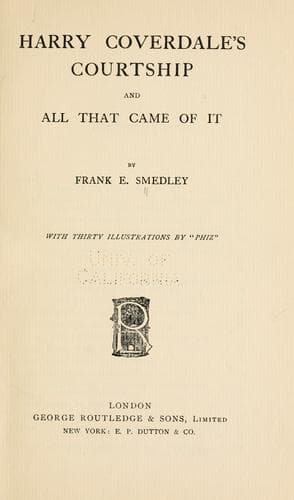
Harry Coverdale's Courtship, and All That Came of ItSmedley, Frank E. (Frank Edward)
General
Harry Coverdale's Courtship, and All That Came of It
Smedley, Frank E. (Frank Edward)
England -- Social life and customs -- 19th century -- Fiction; English fiction -- 19th century
Harry, having once broken the ice, contrived speedily to win the good
opinions (to use no stronger term) of all the female portion of the
community. From the kind attention he paid Mrs. Hazlehurst, he soon
acquired so much influence over that amiable lady that, to please him,
she consented to various schemes devised for her benefit and amusement,
which her daughters had previously urged upon her in vain;--for
instance, when Harry, instructed by Alice in regard to times and seasons
and the like minor particulars, came at the _very_ moment when she was
going to decide that she did not feel equal to going out at all that
day, to tell her that the pony-phaeton was waiting at the door, and
that he should really think her unkind, and imagine he must have done
something to offend her, if she refused to allow him the pleasure of
carrying her to the chaise, and driving her just far enough to do her
good, and not to tire her,--what could she do but consent? _Ce n’est que
le premier pas qui coûte_. This point gained, if was easy to persuade
the invalid to take a short excursion daily; and as her complaint was in
some degree on the nerves, the beneficial effects of the fresh air and
exercise soon became apparent. Moreover, as Alice knew how to drive a
little, and wished to improve in that useful accomplishment, Harry could
do no less, when he had brought Mrs. Hazlehurst safely home from her
daily drive, than take out the young lady, and give her a lesson; and as
these lessons usually lasted some two hours at a stretch, the fat
ponies began to get into excellent working condition, and considering
themselves put upon, wondered why the Society for the Prevention of
Cruelty to Animals neglected to interfere in their behalf. Emily, too,
had quite altered her opinion of their guest, and entirely sympathised
with Tom’s declaration that he was “a stunning good fellow, and no
mistake!” Kate Marsden said little, but observed the progress of events
with calm approval; for she perceived that to be going on, which would
greatly facilitate the execution of certain schemes which she had
devised.
At length arrived the important day of the dinner-party. Were we
called upon to define the meaning of the term dinner-party, we should
denominate it an awful immolation of mind to matter, a wanton sacrifice
of the head to the stomach. Why, on a hot summer’s day, eighteen
individuals, supposed to be in their proper senses, who might dine at
home if they chose, should agree of their own free-will to victimise
themselves and each other by congregating together in one room, for the
space of two mortal hours, to eat--and, in the case of the lords of the
creation, probably to drink also--a great deal more than is good for
them, is one of those social problems of which we expect to arrive at
the solution about the time when mankind is thoroughly regenerated by
Miss Martineau’s _a_theological views (to coin a word), but not before.
Public-domain text, read in full here on John Shaqi.
Reviews
Reviews
No reviews yet
Be the first to share your thoughts on this work.
Elsewhere in the archive
Join the Discussion
Join the discussion
Sign in to leave a comment or review.
Sign InorCreate an account