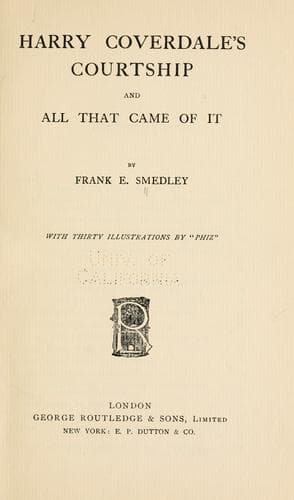
Harry Coverdale's Courtship, and All That Came of ItSmedley, Frank E. (Frank Edward)
General
Harry Coverdale's Courtship, and All That Came of It
Smedley, Frank E. (Frank Edward)
England -- Social life and customs -- 19th century -- Fiction; English fiction -- 19th century
“If I might be allowed to make just one observation before Mr. Coverdale
favours us with his views on this important question,” insinuated
Mr. Crane, in the mildest and most affectionate tone of voice
imaginable--wine always reducing this excellent man to a state of weak
and inappropriate philanthropy--“if I might observe that, with the
highest respect for, and admiration of, the agricultural population
of this great country, I feel it incompatible with my feelings as a
Protestant, and therefore, so to speak, in a general way as a brother,
not to say as a man also, and more particularly as a mill-owner, to
forget the thousands of operatives who crowd our large cities, and who,
when satisfied with cheap bread, add to the dignity and prosperity
of the nation; but, on the contrary, when deprived of this means
of support, object to resign themselves to the dispensations of a
beneficent Providence, and fly in the face of society as chartists,
levellers, red-republicans, and all that is dangerous and subversive of
morality and security of property. If I may so far presume as to call
Mr. Coverdale’s attention to the desirableness of providing food at
a rate which will enable the manufacturing classes to exist without
constantly working themselves up into a state of illegal desperation, I
shall feel that I have, if I may be allowed the expression, unburthened
my conscience.” Thus saying, Mr. Crane cast a timid and appealing look
from Harry to his host, and sipped a glass of Burgundy with the air of a
man apologising for some misdeed.
“It is not a subject upon which I have ever expended any vast amount
of consideration,” began Coverdale, wishing in his secret soul that he
might have the feeding of Mr. Crane for the ensuing six months
entrusted to him, in which case he would have afforded that gentleman
an opportunity of practically testing the merits of _very_ cheap bread
indeed, and of nothing else--except, perhaps, cold spring water; “but
the common sense of the matter appears to lie in a nutshell: the two
great divisions of the poorer classes are the manufacturing poor and
the agricultural poor, the manufacturers being the most numerous--to
sacrifice one to the other is unfair, but to offer up the greater to the
less is ridiculous. Free-trade has had a fair trial, and has been proved
to benefit the masses, though it lies heavily on the land-owners. Well,
then, relieve land of its burthens, and make the income-tax permanent
to reimburse the Exchequer. That’s the line I should take if I were
Premier, which, thank heaven, I’m not.”
Public-domain text, read in full here on John Shaqi.
Reviews
Reviews
No reviews yet
Be the first to share your thoughts on this work.
Elsewhere in the archive
Join the Discussion
Join the discussion
Sign in to leave a comment or review.
Sign InorCreate an account