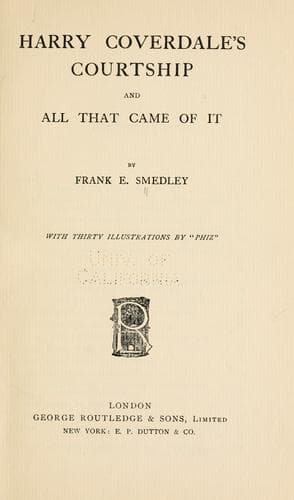
Harry Coverdale's Courtship, and All That Came of ItSmedley, Frank E. (Frank Edward)
General
Harry Coverdale's Courtship, and All That Came of It
Smedley, Frank E. (Frank Edward)
England -- Social life and customs -- 19th century -- Fiction; English fiction -- 19th century
“Why the fact is, my dear fellow,” returned Knighton, a well-disposed
goose, who, when Harry first commenced his college career, had formed
an enthusiastic attachment for him, in return for which he expected his
friend to advise him how to act and what to say upon every occasion,
trifling as well as important--a tax which even Harry’s good-nature
found somewhat oppressive, “the fact is, I consider it quite
providential, if I may say so, finding you here to-night: you know I
always like to have your opinion before I make up my mind; there is
nobody with such good sense as you, at least, nobody that I’ve ever met
with. My dear Coverdale, I’m going to take the most important step--that
is, if you see no reason against it, which I can scarcely feel a doubt
of; but I’ll tell you the whole affair, beginning properly at the
beginning. When I was down in Hampshire three years ago----” but we will
not inflict Mr. Knighton’s amiable prolixity on the reader, suffice it
to say that, having linked his arm within that of Coverdale, he paraded
his victim up and down a gravel walk for the space of at least three
quarters of an hour, while he poured into his ears as dull a tale of
true love as ever ran smooth: true love of the very mildest quality,
which, from the beginning, was certain to end simply and naturally in
a stupid marriage, about the whole of which affair there could not by
possibility be two opinions. At length, when Harry had agreed, with
everything and to everything at least twice over, and strongly advised
his tormentor to act as he felt certain he would have done if his advice
had been just the other way (for this young man, although he eagerly
sought counsel, by no means considered himself bound to walk thereby),
it suddenly occurred to Mr. Knighton that he was doing an unkind thing
by his friend, and a rude one by his host, in not sooner joining the
ladies; accordingly, at (literally) the eleventh hour, he exercised thus
much self-denial, viz. having nothing more to say, he said it.
Public-domain text, read in full here on John Shaqi.
Reviews
Reviews
No reviews yet
Be the first to share your thoughts on this work.
Elsewhere in the archive
Join the Discussion
Join the discussion
Sign in to leave a comment or review.
Sign InorCreate an account