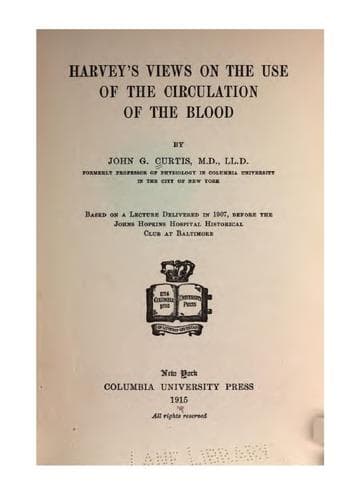
Harvey's Views on the Use of the Circulation of the BloodCurtis, John Green
History
Harvey's Views on the Use of the Circulation of the Blood
Curtis, John Green
Blood -- Circulation; Harvey, William, 1578-1657
Despite emphatic denials of Aristotelian doctrine which Harvey
freely makes in his treatise On Generation, the Aristotelian
flavor of the foregoing passages is obvious. It is not easy to
make out from Harvey's writings the exact nature of his views as
to spontaneous generation. He sometimes seems to assume the truth
thereof; but it is by no means certain that he believed in it in the
same simple sense in which it had been accepted by Aristotle.[439]
Nothing, however, can be clearer than this: that, though for Harvey
the "innate heat" is not ethereal spirits nor even an analogue
of the ether, but is simply identical with the living blood;
nevertheless, for him as emphatically as for Aristotle the "heat in
animals" which "is not fire and does not take its origin from fire,"
derives its origin from the solar ray.
To Harvey, the lifelong thinker upon the meaning of the circulation,
the prodigious history of generation was but continued in the
history of the blood, with which he had identified the "innate heat"
and which he saw appear and live, before all other parts, in the
minute first rudiment of the embryo. We have seen him pondering
the cycle wherein unending life is transmitted from egg to fowl
and from fowl to egg beneath the sun's life-giving rays. So now
shall we see him pondering a cycle of life wherein, from generation
to generation, the circulating blood takes over and exercises
the generative powers of the semen from which it is derived, and
transmits them in turn to the semen evolved out of itself. He says:--
"Further, since we have just seen the study of the semen to be
so difficult; that is to say, the way in which the structure
of the body is built up by the semen with foresight, art, and
divine intelligence; why should we not equally admire the
excellent nature of the blood, and make the same reflections
upon it as upon the semen? Especially since the semen itself
is made of blood,[440] as is proved in the case of the egg;
and since the whole body is seen not only to take origin from
the blood as from a generative part, but also to owe its
preservation to the same."[441]
To this same theme Harvey returns in his Exercise On the Innate Heat
near the end of his treatise On Generation, saying:--
Public-domain text, read in full here on John Shaqi.
Reviews
Reviews
No reviews yet
Be the first to share your thoughts on this work.
Elsewhere in the archive
Join the Discussion
Join the discussion
Sign in to leave a comment or review.
Sign InorCreate an account