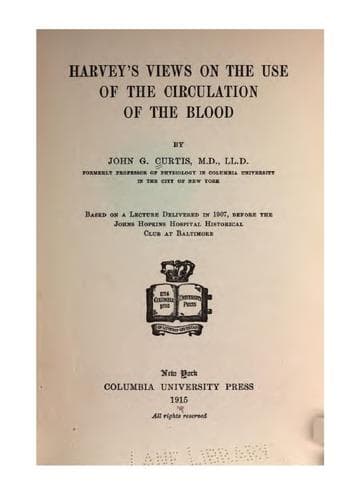
Harvey's Views on the Use of the Circulation of the BloodCurtis, John Green
History
Harvey's Views on the Use of the Circulation of the Blood
Curtis, John Green
Blood -- Circulation; Harvey, William, 1578-1657
"The following few points should be considered well by every
diligent mind, and so the fact becomes established more clearly,
that those remarkable virtues which learned men attribute to
the spirits and the innate heat are appropriate to the blood
alone; to say nothing of what is so wonderfully striking in the
egg before aught of the embryo has appeared, and in the perfect
and developed embryo also. To be sure, the blood, considered
absolutely and by itself outside the veins and regarded as
consisting of elements[453] and as composed of different
parts,--some thin and serous, some thick and solidified,--is
termed 'cruor' and is possessed of very few virtues, and those
obscure. But the blood, when present within the veins as a part
of the body, a generative part, too, and endowed with soul,
being the soul's immediate instrument and primary seat--the
blood, seeming also to have a share of another diviner body
and being suffused with divine heat, certainly acquires
extraordinary powers, and is analogous to the element of the
stars. As spirits the blood is the hearth, the Vesta,[454] the
household deity, the innate heat, the sun of the microcosm, the
fire of Plato;[455] not because it shines, burns, and destroys,
like common fire, but because it preserves and nourishes and
increases its very self by its perpetual wandering motion.
Moreover, the blood deserves the name of spirits because,
primarily and before all other parts, it abounds in radical
moisture, that is, in the final and most immediate form of
nourishment; and the same fare wherewith the blood itself is
nourished is made ready by it and given out to all other parts
while it is coursing perpetually through the entire body.
Indeed, the blood nourishes, fosters, and keeps alive all the
parts which it constructs and adjoins to itself, even as the
heavenly bodies above, especially the sun and moon, impart life
to what is below, while they continue in perpetual circulation.
Since, therefore, the blood acts beyond the powers of the
elements and is potent with those virtues aforesaid, and also
is the instrument of the supreme workman, no one ever will give
praise enough to its wonderful and divine faculties."[456]
Let us end these studies by picturing to ourselves the memorable
figure of the small white-haired man ensconced in one of his
favorite nooks on the leads of his brother's house, musing upon the
mystery of the circulation, and linking it with that of
"The shining powers, conspicuous afar
Against the ether, which to mortals bring
Winter and summer."[457]
NOTES
[1] In the present paper frequent references will be made to the
writings of Harvey, Galen, Aristotle, and Hippocrates. Citations
from these authors will be made from the following editions:--
Public-domain text, read in full here on John Shaqi.
Reviews
Reviews
No reviews yet
Be the first to share your thoughts on this work.
Elsewhere in the archive
Join the Discussion
Join the discussion
Sign in to leave a comment or review.
Sign InorCreate an account