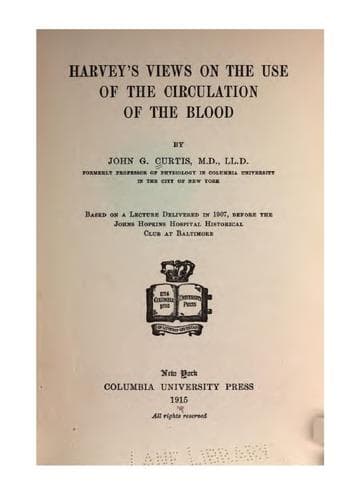
Harvey's Views on the Use of the Circulation of the BloodCurtis, John Green
History
Harvey's Views on the Use of the Circulation of the Blood
Curtis, John Green
Blood -- Circulation; Harvey, William, 1578-1657
[126] Harvey: On the Motion, etc., IV, Syd. 30, l. 14-18 and 30, l.
31 to 31, l. 4; Op. Omn. 32, l. 8-10 and 32, l. 22-30.
[127] Aristotle: On the Parts of Animals, 666_a_, 8-13.
[128] _Principium._
[129] Harvey: On the Motion, etc., XVI, Syd. 74, l. 4-15; Op. Omn.
75, l. 9-19.
[130] It would be natural to conjecture that this Aristotelian
slighting of spirits derived from the air, taken in connection with
Aristotle's exaltation of the vital innate heat, may have had much
weight with Harvey, who, although he used the word "spirits" freely,
insisted that the blood and the spirits are one. But in this matter
the Aristotelian precedent cannot have had the same force for Harvey
that it would have for us, because he believed Aristotle to be the
author of two treatises in which the spirits are expressly treated,
not only as entities, but as entities of great physiological
importance, though their relations with the outer air are neglected
in one of the treatises and quite obscurely dealt with in the
other. (See Harvey: On the Motion, etc., IV, Syd. 29, l. 16-25;
Op. Omn. 31, l. 8-16. Do., VI, Syd. 38, l. 7-12; Op. Omn. 40, l.
2-5.) Indeed, Harvey in one of his references to Aristotle directly
affirmed that the philosopher had believed in "motor spirits" within
the animal body. (See Harvey: On the Motion, etc., XVII, Syd. 81, l.
8-12; Op. Omn. 82, l. 31 to 83, l. 3. Compare [Pseudo-] Aristotle:
On Spirits, 485_a_, 5-8; and the Latin translation of the same
"by an unknown interpreter," 249_b_, 13-18.) The two treatises in
question are entitled, respectively, "On the Motion of Animals" and
"On Spirits," and have been attributed to Aristotle and habitually
printed among his works, both before and since the time of Harvey.
Modern criticism, however, has made it clear that neither treatise
is a genuine work of Aristotle. It is especially plain that the
treatise "On Spirits" is by another hand and of another school;
among other reasons, because the author declares the skin to be
supplied with blood by the veins, and with spirits by accompanying
vessels which he calls "arteries." In this treatise the maintenance
of the spirits by respiration is discussed, but left uncertain
(483_b_, 15-19). It is but fair to the criticism of Harvey's
time to note that, glaringly at variance as the undoubted works
of Aristotle are with the treatise "On Spirits," the latter was
pronounced genuine, in 1839, by so eminent a scholar as É. Littré,
in his "Œuvres d'Hippocrate," etc., Vol. I, 203. Reasons why the
treatises in question are not by Aristotle, are given at length in
the essay in Latin by V. Rose, entitled "De Aristotelis Librorum
Ordine et Auctoritate Commentatio," Berlin, 1854, 162-171, and at
the end of 174.
[131] Compare the Iliad, Book XXI, 441.
[132] ἐν τούτῳ γὰρ ἡ φύσις ἐμπεπύρευκεν ἀυτήν. Aristotle:
On Respiration, 474_b_, 10-13.
[133] Aristotle: On Youth and Old Age, etc., 469_a_, 11-12 and 17-20.
[134] Plato: Timæus, 70_a_-_b_ and 77_d_-_e_.
Public-domain text, read in full here on John Shaqi.
Reviews
Reviews
No reviews yet
Be the first to share your thoughts on this work.
Elsewhere in the archive
Join the Discussion
Join the discussion
Sign in to leave a comment or review.
Sign InorCreate an account