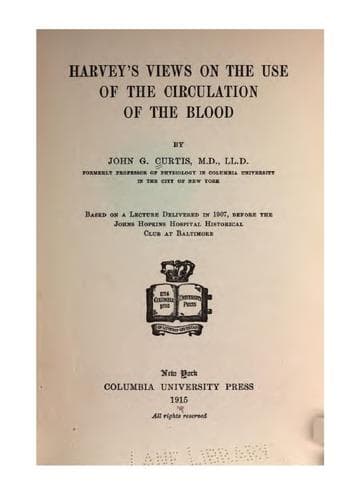
Harvey's Views on the Use of the Circulation of the BloodCurtis, John Green
History
Harvey's Views on the Use of the Circulation of the Blood
Curtis, John Green
Blood -- Circulation; Harvey, William, 1578-1657
It was not Greek philosophy alone in which in ancient times the word
corresponding to "soul" was used in a wider sense than that of the
quotation from "Hamlet." In the English Authorized Version of the
Old Testament, first published in 1611, we read in Genesis II, 7:
"Man became a living soul." The reading is the same in the Revised
Version of 1885. In Genesis I, 30, we read in both versions: "And
to every beast of the earth, and to every fowl of the air, and to
every thing that creepeth upon the earth, wherein _there is_ life,
_I have given_ every green herb for meat." In both versions it is
noted in the margin that the expression translated by the single
English word "life" is, in the Hebrew, "a living soul." Accordingly
we find this Hebrew expression of Genesis I, 30, rendered "a soul
of life"--ψυχὴν ζωῆς,--in the ancient translation of
the Old Testament into Greek, known as the "Septuagint," which was
probably completed less than two hundred years after the death of
Aristotle and more than one hundred and fifty years before the
Christian era. In the early Latin translation of the Scriptures
which was finished in A.D. 405, and is largely embodied in the
"Vulgate" of to-day, we read in the same verse--Genesis I, 30,
"_anima viviens_"--"a living soul." In Genesis II, 7, where the
reference is to man himself and the English Bible reads "a living
soul," the Vulgate reads "_animam viventem_," using the same Latin
words as for the lower creatures of I, 30. In like manner the
Septuagint reads in Genesis II, 7, ψυχὴν ζῶσαν, as it
reads in I, 30, ψυχὴν ζωῆς. Other instances from the Book
of Genesis could be cited of the wide significance given therein to
the expression which corresponds to "soul."
[281] _Domi._ Compare Aristotle: On the Generation of Animals,
736_a_, 24 to 737_b_, 7.
[282] Harvey: On Generation, LXXI, Syd. 511, l. 1-24; Op. Omn. 532,
l. 9-29.
[283] _Neque sanguinis vim, virtutem, rationem, motum, aut calorem,
ut cordis domum, habet._ Harvey: Exercise to Riolanus, II, Syd. 137,
l. 16-17; Op. Omn. 137, l. 8-9.
[284] Hippocrates: On the Nature of Man, Lit. Vol. VI, 44, l. 7-10.
[285] Harvey: On Generation, XVII, Syd. 239, l. 13-23 and l. 29-31;
Op. Omn. 253, l. 3-11 and l. 15-18.
[286] Harvey: On Generation, LVII, Syd. 430, l. 23-33; Op. Omn. 449,
l. 11-21.
[287] _Promanat._
[288] Harvey: On Generation, XLVII, Syd. 347, l. 26 to 348, l. 3;
Op. Omn. 363, l. 18 to 364, l. 2.
[289] _Primigenia._
[290] Harvey: On Generation, LI, Syd. 375, l. 40 to 376, l. 8; Op.
Omn. 392, l. 3-10.
[291] Leviticus XVII, 11 and 14--Harvey's own reference. Not these
two verses merely, but the whole of chapter XVII, should be read,
not only in the Authorized Version, but in the Revised Version also.
[292] Harvey: On Generation, LI, Syd. 376, l. 19-21; Op. Omn. 392,
l. 20-22.
[293] Harvey: On Generation, LI, Syd. 377, l. 3-11; Op. Omn. 393, l.
7-14.
[294] Harvey: On Generation, LII, Syd. 380, l. 14-16; Op. Omn. 396,
l. 18-20.
Public-domain text, read in full here on John Shaqi.
Reviews
Reviews
No reviews yet
Be the first to share your thoughts on this work.
Elsewhere in the archive
Join the Discussion
Join the discussion
Sign in to leave a comment or review.
Sign InorCreate an account