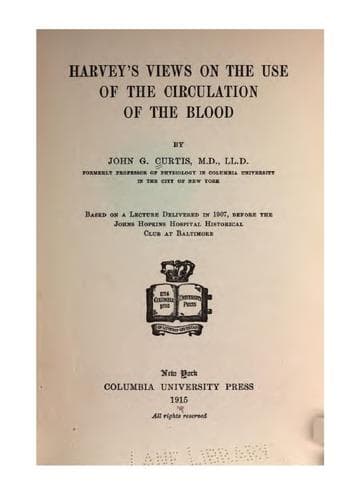
Harvey's Views on the Use of the Circulation of the BloodCurtis, John Green
History
Harvey's Views on the Use of the Circulation of the Blood
Curtis, John Green
Blood -- Circulation; Harvey, William, 1578-1657
"We find the blood formed before anything else in the egg and
in the product of conception;[174] and almost at the same time
the receptacles of the blood, the veins and the pulsating
vesicle, become plainly visible. Wherefore, if the leaping point
together with the veins and blood, which are all conspicuous
as one single organ at the first beginning of the embryo, be
accepted as the heart (the parenchyma of which is superadded
to the vesicle later in the formation of the embryo), it is
manifest that, accepted in this sense, that is, as an organ
composed of parenchyma, ventricles, auricles, and blood, the
heart in animals is in very truth, as Aristotle would have it,
the principal and first generated part of the body; of which
part, however, the first and foremost part is the blood, both by
nature and in the order of generation."[175]
In the following third passage of the same treatise no reconciling
interpretations of the master's words are to be found; flat
disagreement with Aristotle is declared; and the "Sun of the
Microcosm"[176] declines nearly to its simple modern status of a
living pump! Harvey says:--
"Nor can I agree with Aristotle himself, who maintained that
the heart is the primary generative part and that it is endowed
with soul; for, truly, I believe the blood alone to be entitled
to these distinctions, since the blood it is which first appears
in generation; and that such is the case not only in the egg but
also in every fœtus and very early animal embryo, shall at
once be made plain.[177]
"At the beginning, I say, there appear the red leaping point,
the pulsating vesicle, and filaments, derived thence, which
contain blood in their interior. And, so far as can be discerned
by accurate inspection, the blood is made before the leaping
point is formed, and the blood is endowed with vital heat before
it is set in motion by pulsation; and, further, as pulsation
is begun in and by the blood, so at last it ends in the blood
at the final instant of death. Indeed, by numerous experiments
done upon the egg and otherwise I have made sure that it is
the blood in which the power of returning to life persists, so
long as the vital heat has not wholly vanished. And since the
pulsating vesicle and the sanguineous filaments derived from it
are seen before anything else, it stands to reason in my belief
that the blood is prior to its receptacles--the contained, that
is, to its container--since the latter is made for the use of
the former. Therefore, it is probable that the filaments and
the veins and then the vesicle and at length the heart, having
organs destined to receive and retain the blood, are made for
the sole purpose of transmitting and distributing it, and that
the blood is the principal part of the body....
Public-domain text, read in full here on John Shaqi.
Reviews
Reviews
No reviews yet
Be the first to share your thoughts on this work.
Join the Discussion
Join the discussion
Sign in to leave a comment or review.
Sign InorCreate an account