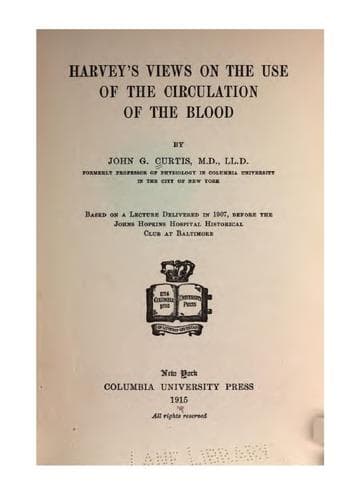
Harvey's Views on the Use of the Circulation of the BloodCurtis, John Green
History
Harvey's Views on the Use of the Circulation of the Blood
Curtis, John Green
Blood -- Circulation; Harvey, William, 1578-1657
"Moreover, if an egg be exposed too long to a colder atmosphere,
its leaping point pulsates less often and stirs more languidly;
but if a warm finger be applied to it, or any other bland source
of warmth, straightway it recovers strength and vigor. Indeed,
when such a point has become gradually weak and though full of
blood ceases to move at all and gives no sign of life, seeming
utterly to have succumbed to death, if my lukewarm finger be
placed over it for the space of twenty pulsations of my artery,
behold! the little heart revives once more, becomes erect, and
renews its pristine dance as though come back from Hades. This
I myself and others, too, have brought about again and again by
means of gentle warmth of any kind, such as that of a fire or of
tepid water; thus at our pleasure being able to give over the
poor little soul to death, or call it back to the light."[201]
As in the embryo the leaping point may be revived by external
warmth, so may the heart in the full-grown bird. In his treatise of
1628 Harvey says:--
"In the pigeon, at any rate, at an actual experiment, after the
heart had wholly ceased to move and even the auricles had left
off moving, I placed my finger, wetted with saliva and warm,
upon the heart and kept it there for a while; as the result of
which fomentation the heart, as though restored to strength and
life again, and its auricles with it, were seen to move and
contract and relax themselves and, as it were, to be recalled
from death."[202]
In his treatise On Generation, Harvey confirms the doctrine of the
primacy of the blood by citing observations made upon sluggish or
hibernating animals and also certain morbid phenomena in man, as
follows:--
"This, too, clearly follows from many observations; especially
the cases of certain animals which possess blood yet live a long
time without a pulse; and of some which lie hidden the whole
winter and, nevertheless, continue alive, although meanwhile all
movement of the heart has ceased and their lungs enjoy a rest
from breathing, like people who lie half dead and pulseless in
syncope or faintness or hysterical affections."[203]
Public-domain text, read in full here on John Shaqi.
Reviews
Reviews
No reviews yet
Be the first to share your thoughts on this work.
Elsewhere in the archive
Join the Discussion
Join the discussion
Sign in to leave a comment or review.
Sign InorCreate an account