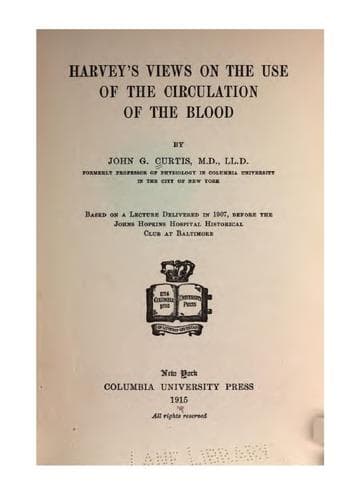
Harvey's Views on the Use of the Circulation of the BloodCurtis, John Green
History
Harvey's Views on the Use of the Circulation of the Blood
Curtis, John Green
Blood -- Circulation; Harvey, William, 1578-1657
"In the heart the swelling up from heat of the liquid which
is always arriving from the food produces pulsation, for the
swelling rises against the outer tunic[214] of the heart; and
this process is always and incessantly going on, for the liquid
is always and incessantly flowing in, out of which the nature
of the blood arises; for the blood is first worked up in the
heart. The thing is plain in generation from the beginning; for
before the vessels have been marked out the heart is to be seen
containing blood. Hence, too, it pulsates more in the young than
in the old; for the vapor[215] arises more abundantly in the
young.
"All the vessels also pulsate and do so simultaneously one with
another, because they are dependent upon the heart.[216] This
is always moving, so that they, too, are always moving, and
simultaneously one with another, when[217] the heart moves.
Leaping [of the heart],[218] then, is the reaction which takes
place against the condensation produced by cold, and pulsation
is the vaporization[219] of heated liquid."[220]
In another treatise Aristotle says: "In all animals the blood
pulsates in the vessels everywhere at the same time."[221] It
is interesting, in a negative way, that his sweeping and faulty
references to the pulsation of the vessels put into words no
physiological idea except the vague one of "dependence" on the heart.
One may be tempted to see in the seething of the heart's blood the
source of some of those spirits within the body elsewhere than in
and about the heart, of which one gets brief ill-defined glimpses
here and there in the genuine works of Aristotle. But no words of
his can be adduced to confirm such a conjecture.
Evidently, however, the seething of the nascent blood suffices, in
Aristotle's eyes, to explain both the phases of the heart-beat;
for both the rising and the falling of the wall of the hot central
laboratory of the blood are movements as passive apparently as
those of the lid of a boiling pot. One may be excused for wondering
at the crudity of such a conception; nor is one's wonder lessened by
recalling that elsewhere in Aristotle's works he places at the heart
the central origin of the bodily movements. But when it is recalled,
as well, that Aristotle was totally ignorant of the function of
muscle and, therefore, even of the mode of working of the limbs, his
doctrine of the heart-beat may seem less amazing.
Public-domain text, read in full here on John Shaqi.
Reviews
Reviews
No reviews yet
Be the first to share your thoughts on this work.
Elsewhere in the archive
Join the Discussion
Join the discussion
Sign in to leave a comment or review.
Sign InorCreate an account