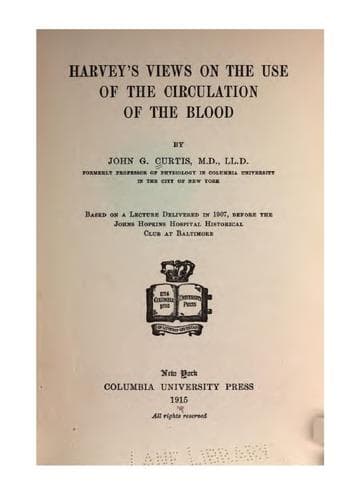
Harvey's Views on the Use of the Circulation of the BloodCurtis, John Green
History
Harvey's Views on the Use of the Circulation of the Blood
Curtis, John Green
Blood -- Circulation; Harvey, William, 1578-1657
Harvey seems to have attributed more importance to the auricular
systoles than do the physiologists of to-day, he making the
ventricles depend very greatly for their charge of blood upon the
systole of the auricles. This view appears in three passages already
quoted; and is tersely put by Harvey when he says elsewhere that
the heart "is dilated by the auricle, contracts of itself";[231]
that "the auricles are prime movers of the blood."[232] The unduly
high value set by him upon the auricular systole agrees well
with the polemical vigor with which Harvey exalted impulsion and
rejected suction,[233] in his general physiology as well as in
the physiology of the heart. In the heart especially the force of
suction had played for centuries a part which Harvey rejected more
completely than the physiologists of to-day feel warranted in doing.
Again he shall speak for himself, saying tersely:--
"Hence it is made plain how the blood enters the ventricles;
not by reason of being drawn in, or of the heart expanding, but
because sent in by the pulse of the auricles."[234]
"The expansion of the heart," he has told us already, "is a movement
of a certain violence, produced by impulsion, not by attraction of
some sort." He says that he maintains these views
"against the commonly received opinion; because neither the
heart nor anything else can so expand itself that it can draw
anything into itself in its diastole, unless as a sponge does
which has first been forcibly compressed and is returning to its
natural state."[235]
But, one may ask oneself, how does that modified seething in the
vena cava which produces the diastole of the right auricle produce
the diastole, the simultaneous diastole, of the left auricle? In his
lecture notes Harvey had stated, as Columbus had before him, that
the venous artery does not pulsate--at least, he means, not in the
same sense as the auricle, or ventricle, or artery.[236] Obviously
regarding the left auricle there could be available, for Harvey, no
explanation parallel to that of to-day, viz.: the swift conduction
of a stimulus from point to point of the texture of a wall which is
common to both auricles. He is careful to state that corresponding
auricular events occur simultaneously and in the same way in the
two auricles; and incidentally but frankly he confesses ignorance of
the reasons why, in the following passage:--
"From those who declare the causes and reasons of all things
in such a smattering way, I would be glad to learn how it is
that both eyes move together hither and thither and in every
direction when they look; how it is that this eye does not turn
by itself in that direction, that eye in this; likewise, both
auricles of the heart; and so forth."[237]
Public-domain text, read in full here on John Shaqi.
Reviews
Reviews
No reviews yet
Be the first to share your thoughts on this work.
Elsewhere in the archive
Join the Discussion
Join the discussion
Sign in to leave a comment or review.
Sign InorCreate an account