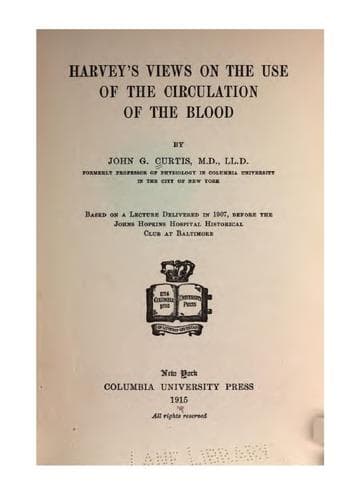
Harvey's Views on the Use of the Circulation of the BloodCurtis, John Green
History
Harvey's Views on the Use of the Circulation of the Blood
Curtis, John Green
Blood -- Circulation; Harvey, William, 1578-1657
"Moreover, whoever shall have seen and thought upon the amount
of difficulty and exertion with which the blood is stanched by
compression, ligatures, or various appliances, when it leaps
impetuously out of a petty artery, even the smallest, which
has been cut or torn in two; and shall have seen or thought
upon the amount of force with which the blood, as though thrown
out from a syringe, flings off and drives before it the whole
of the appliances, or traverses them--that man will hardly
believe it probable, I think, that any of the blood can pass
backward against so great an impulse and influx of the entering
blood, unless from a point whence it is driven back with equal
force."[254]
Harvey rightly discountenanced the ancient idea of direct
anastomoses between the mouths of veins and the mouths of
arteries, as opposed to fine and multiplied communications. In
some situations, however, he admitted that ampler communications
exist comparable to such anastomoses; and it throws light upon
his state of mind as to the movement of the blood that, despite
his recognition of the very forcible exit of the blood from the
arteries, he suggested in his old age that in the cases aforesaid
regurgitation from vein to artery is guarded against by a valvular
arrangement, the terminal part of the artery traversing the wall of
the vein obliquely, as the ureter traverses the wall of the bladder
and as the biliary duct traverses the wall of the duodenum.[255]
We should not forget that in his day the capillary vessels, the
existence of the corpuscles, and the chemistry of the blood were
still unknown; so that the passage into the veins of the mysterious
hot vital liquid through the "porosities" of the parts might
naturally present itself to his mind in a way very strange to us. He
tells us this:--
"The blood does not take its course through the looser texture
of flesh and parenchyma in the same way as through the more
compact consistency of tendinous parts. Indeed, the thinner and
purer and more spirituous part passes through more quickly; the
thicker, more earthy, ill-composed[256] part tarries longer and
is rejected."[257]
After more than twenty years of the comment and criticism, called
forth by his treatise of 1628, he said to Riolanus:--
"As to whether the moving blood be attracted, or impelled, or
move itself by virtue of its own intrinsic nature, enough has
been said in my little book on the motion of the heart and
blood."[258]
Yet about two years after the Exercises to Riolanus, Harvey, in
writing a private letter, judged it necessary to accentuate, as
follows, his denial that forces of attraction really play the part
in physiology which the ancients had conceded to them. Speaking of
the impulsion of the blood through the arteries, he says:--
Public-domain text, read in full here on John Shaqi.
Reviews
Reviews
No reviews yet
Be the first to share your thoughts on this work.
Elsewhere in the archive
Join the Discussion
Join the discussion
Sign in to leave a comment or review.
Sign InorCreate an account