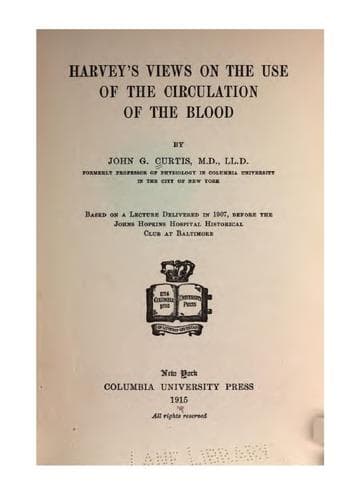
Harvey's Views on the Use of the Circulation of the BloodCurtis, John Green
History
Harvey's Views on the Use of the Circulation of the Blood
Curtis, John Green
Blood -- Circulation; Harvey, William, 1578-1657
Despite the protean forms of the spirits it is not till we have
reached Harvey's Exercise On the Innate Heat that we have fallen
in with spirits in the blood which, for some of his predecessors,
"constitute an innate heat more excellent and more divine, as it
were"; nor with "a spirit, another innate heat, of celestial origin
and nature." For this treatment of spirits within the blood and
of innate heat, as convertible terms, the way may well have been
paved by the words in which Aristotle intimates that the generative
heat of the semen resides in the spirits therein, _i.e._, in hot
vapor produced within the body of the male and included within the
films of foam-bubbles in the semen. Referring to "the so-called
heat" the words of Aristotle are: "Yet this is not fire nor any
such power, but the spirits included in the semen and in foaminess,
and in the spirits the nature which is analogous to the element of
the stars."[347] The transition can hardly have been too difficult
from the view of Aristotle that in the spirits of the semen is heat
which is not elemental fire, to the view combated by Harvey that the
spirits of the blood are heat which is not elemental fire.
Aristotle's striking biological doctrine that the generative seminal
heat is a "nature which is analogous to the element of the stars"
appears to be an obvious source of those seeming fantasies, written
down eighteen centuries later, at which Harvey girds when he says:
"For what we so commonly would fetch from the stars is born at
home." If we use our judgment simply, upon Harvey's statement of
their opinions, the men whom he castigates, having strayed from the
ancient master's footsteps by making the spirits one and the same
with the innate heat instead of the vehicle thereof, next stray
still more blindly by identifying this heat, _alias_ these spirits,
not with an analogue of the ether, but with a portion of the ether
itself. Therefore is it that we read in the words of Harvey's
polemic, of "that foreign guest, ethereal heat"; of those spirits
"aërial or ethereal, or composed of substance both ethereal and
elemental"; of spirits "which draw their origin from heaven" and
elicit Harvey's ironical wonder that they "should be nourished by
our common and elemental air." Therefore, too, is he able to tell us
of that amazing spirit, _alias_ innate heat, which is "a body" and
qualified by many imposing adjectives and finally styled "ethereal
and sharing in the quintessence." The doctrine of Aristotle that
in the semen there are spirits which are the vehicle of generative
heat which is analogous to the element of the stars, is a baseless
doctrine, but it is a subtle and far-reaching speculation. The
doctrine stated and attacked by Harvey that in the blood there are
spirits which are the innate heat, which consists as a whole or in
part of the element of the stars, is not only a baseless doctrine,
as Harvey vigorously shows, but certainly is lame as speculation
Public-domain text, read in full here on John Shaqi.
Reviews
Reviews
No reviews yet
Be the first to share your thoughts on this work.
Elsewhere in the archive
Join the Discussion
Join the discussion
Sign in to leave a comment or review.
Sign InorCreate an account