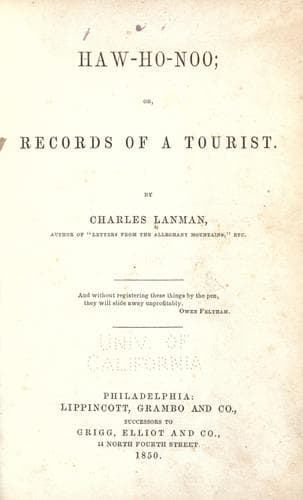
Haw-Ho-Noo; Or, Records of a TouristLanman, Charles
History
Haw-Ho-Noo; Or, Records of a Tourist
Lanman, Charles
Fishing -- North America; United States -- Description and travel
As to the remaining fresh-water fish of the country, we will content
ourself by merely mentioning the names of those which are known to our
anglers, to wit: the chub, dace, white basse, sunfish, roach, bream, and
rock basse. The fish called in Virginia and Maryland the fall fish is
identical with the dace. In the waters of the West the mullet, fresh
water sheepshead, and sucker, are found in immense numbers, but they are
all exceedingly poor eating, and as sporting fish are of no account. The
sturgeon, we believe, is found almost everywhere, and known to almost
everybody.
There is a fish found in Florida which we have never seen, but which,
from all the descriptions that we have heard, belongs either to the
trout or basse families. It abounds in all the rivers, lakes and springs
of this State, is a bold biter, reaches the weight of fifteen pounds,
has a white and sweet flesh, and is taken in very much the manner
employed by northern anglers in capturing the pike, and with similar
artificial baits.
We now come to our favorites of the ocean and tide-water rivers; and the
first fish that we mention is the _black fish_, or _tautog_, as it was
called by the Mohegan Indians. It is a stationary inhabitant of the salt
water, and usually found upon reefs and along rocky shores. It is taken
all along the Atlantic coast between New York and Boston, but it has
been known north of Cape Cod only within a few years; its legitimate
home is Long Island Sound. It is an active, bold, strong, and tough
fish, highly esteemed as an article of food, and, like the cod, is
brought to the principal markets in floating cars, in which confinement
they are said to fatten. They are by no means a handsome fish, and their
scales are so adhesive as to be taken off only with the skin. They are a
summer fish, being taken as early as April, and no later than October. A
three-pounder is considered a good fish, but we have often taken them
weighing ten pounds, and have seen them weighing fifteen pounds. They
are generally taken with the hand line, and no better bait can be
employed than the lobster or soft crab.
_The Sheepshead._—This is a thick set but rather handsome fish, and, for
the sweetness of its flesh, highly esteemed. They are seldom seen in the
New York market, but very common in the Charleston and Mobile markets,
from which we infer that they are partial to southern waters. They vary
in weight from three pounds to fourteen; live exclusively upon shell
fish, and invariably command a high price. They are popular with the
anglers, for they swim in shoals and are captured with but little
trouble.
Public-domain text, read in full here on John Shaqi.
Reviews
Reviews
No reviews yet
Be the first to share your thoughts on this work.
Elsewhere in the archive
Join the Discussion
Join the discussion
Sign in to leave a comment or review.
Sign InorCreate an account