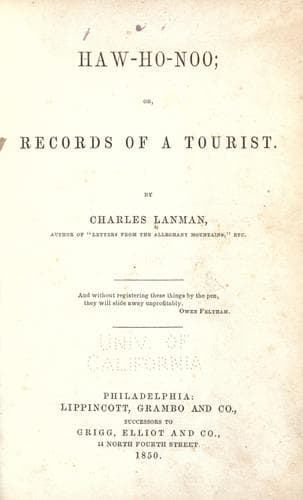
Haw-Ho-Noo; Or, Records of a TouristLanman, Charles
History
Haw-Ho-Noo; Or, Records of a Tourist
Lanman, Charles
Fishing -- North America; United States -- Description and travel
Attended by police officers, we once paid a visit to a building called
the Old Brewery, which infests the city of New York as does a cancer the
bosom of a splendid woman. At the time in question, it was a very large
and rickety affair, and the _home_ of about _eighty pauper families_;
and we verily believe contained more unalloyed suffering than could have
been found in any other building in the United States. It belonged to
the city, and was rented by a woman, who, in her turn, rented it out by
piecemeal to the paupers. For many years it was a dram shop or a college
for the education of drunkards, and it is now the comfortless hospital
or dying-place of those drunkards and their descendants. We visited this
spot at midnight, and were lighted on our way by torches which we
carried in our hands.
Having passed through a place called Murderer’s Alley (on account of the
many murders committed there), our leading officer bolted into a room,
where was presented the following spectacle. The room itself was more
filthy than a sty. In the fireplace were a few burning embers, above
which hung a kettle, tended by a woman and her daughter. It contained a
single cabbage, and was all they had to eat, and the woman told us she
had not tasted food for twenty-four hours. The wretched being, it
appears, had been engaged in a fight with some brute of a man, who had
so severely bruised her face that one whole side was literally black and
blue. We asked her some questions and alluded to her young daughter. She
replied to our inquiries, and then burst into tears, and wept as if her
heart was broken. The only comment which the daughter made was, “Mother,
what are you crying about? Don’t make a fool of yourself. Tears will not
wipe away God’s curse.” The couch to which this pair of women were to
retire after their midnight meal, was a pallet of straw, wet with liquid
mud that came oozing through the stone walls of the subterranean room.
This woman told us that her husband was in the State prison, and that
she was the mother of seven daughters, all of whom but the one present
had died in girlhood, utterly abandoned to every vice. “Yes,” added the
woman, “and I hope that me and my Mary will soon join them; there can be
no worse hell than the one we are enduring.” She mourned over her
unhappy fate, and looked upon vice as a matter of necessity—for they
could not starve.
Public-domain text, read in full here on John Shaqi.
Reviews
Reviews
No reviews yet
Be the first to share your thoughts on this work.
Elsewhere in the archive
Join the Discussion
Join the discussion
Sign in to leave a comment or review.
Sign InorCreate an account