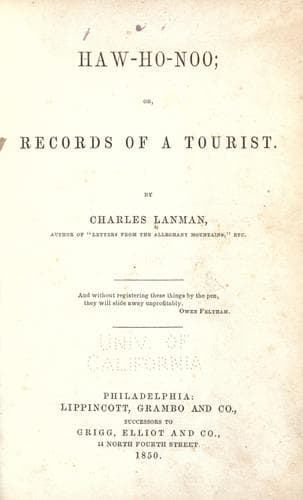
Haw-Ho-Noo; Or, Records of a TouristLanman, Charles
History
Haw-Ho-Noo; Or, Records of a Tourist
Lanman, Charles
Fishing -- North America; United States -- Description and travel
Morning dawned, and the pleasant sunshine was flooding the world with
beauty. Our Mary’s cousin was the first to awaken from slumber, when she
encircled her bedfellow with her arms, and imprinted an affectionate
kiss upon her lips; one moment more, and she was petrified with
horror—for Mary Marlowe was numbered with the dead.
On the third day after that of St. Valentine, the lover of the unhappy
suicide returned to the city. He found not his beloved in the pleasant
parlor of her father, but a sleeper in the voiceless and desolate tomb.
The fatal valentine was found and submitted to his inspection. He avowed
his utter ignorance of it, and having fallen into a settled melancholy,
is now a raving maniac. As to the thoughtless and wicked man who wrote
the foolish valentine, his name and purpose are alike unknown.
Note.—The prominent features of this incident actually occurred in the
city of New York in February, 1847.
INDIAN LEGENDS.
NOTE PRELIMINARY.
The following romantic but authentic legends have been collected by the
writer from a variety of sources, and are now presented to the public as
an addition to the aboriginal lore, already published in his several
books of travel.
INDIAN LEGENDS.
THE SHOOTING METEORS.
Among the Indians who live upon the north-eastern shore of Lake Huron, a
remnant of the Iroquois, it is believed that the heavens contain only
four meteors which have the power of shooting through the sky. It is
thought they severally occupy the four quarters of the compass, and that
they never perform their arrowy journey excepting for the purpose of
warning the Huron Indians of approaching war. The meteors in question,
or Pun gung-nung, are recognized by their peculiar brilliancy, and
universally considered the Manitoes or guardian spirits of the entire
Indian race. They came into existence at the same period of time which
witnessed the creation of Lake Huron itself, and the legend which
accounts for their origin is distinguished for the wild and romantic
fancies of the aborigines. I obtained it from a chief named _On
qwa-sug_, or Floating Wood.
It was the winter time, and an Indian with his wife and two children, a
daughter and a son, were living in a wigwam on a bleak peninsula of the
Great Lake. The game of that section of country had nearly all
disappeared, and the fish were spending the season in such deep water,
that it was quite impossible to secure any of them for food. Everything
seemed to go wrong with the poverty-stricken Indian, and he was
constantly troubled with the fear that the Master of Life intended to
annihilate his family and himself by starvation. He expressed his
anxiety to his wife, and was surprised to hear her answer him with a
song.
Public-domain text, read in full here on John Shaqi.
Reviews
Reviews
No reviews yet
Be the first to share your thoughts on this work.
Elsewhere in the archive
Join the Discussion
Join the discussion
Sign in to leave a comment or review.
Sign InorCreate an account