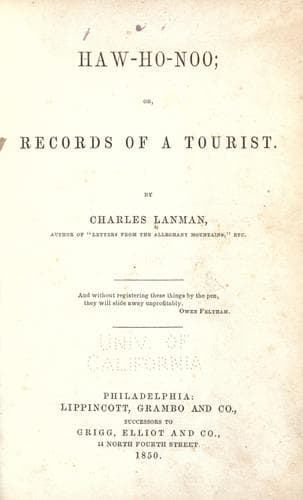
Haw-Ho-Noo; Or, Records of a TouristLanman, Charles
History
Haw-Ho-Noo; Or, Records of a Tourist
Lanman, Charles
Fishing -- North America; United States -- Description and travel
Another day was nearly gone, and the unhappy pair were standing in front
of their wigwam watching the western sky, as the sun enlivened it with
his parting beams. The old man pointed to the bright picture, and told
the boy that there was the gateway to the Spirit Land, where perpetual
summer reigned, and game was found in great abundance. He spoke too of
the child’s father and mother, and of his little brother, whom he
described as decked out in the most beautiful of robes, as they wandered
through the forests of that distant, shadowy land. The boy, though
suffering with the pangs of hunger, clapped his little hands in glee,
and told his grandfather that it would make him very happy if he could
go to the land of perpetual summer. And then it was that the old man
patted the boy upon his head, and told him that his desires should be
realized before the sun again made its appearance above the snow-covered
mountains and plains of the east.
It was now the hour of midnight. Intensely cold was the wind which swept
over the wilderness, but the sky was very blue, and studded with many
stars. No sound broke upon the air, save the occasional groan of the ice
along the lake shore, and the hissing whisper of the frost. Within the
Indian lodge, which was the very home of desolation, the child was
sweetly sleeping, enveloped in his robes, while the old man bent over
the burning embers as if in despair. Some inhuman thought had crazed his
brain, and he was nerving himself for an unheard of crime. One moment
more, and in the dim light of that lonely lodge, gleamed the polished
blade of a flinty weapon—a sudden groan was heard—and the Indian maniac
was feeding upon the body of his child.
I have given the white man a sorrowful history, but it is one which the
Chippeway nation believe. On the morning which followed the event I have
now narrated, a party of Indian hunters came to the cabin of the unknown
man, and they found him lying dead upon the ground, with the mangled
remains of the boy at his side. This was the most terrible deed which
ever happened in the Chippeway country—and the one which so greatly
offended the Great Spirit, that he pronounced a curse upon the man who
had destroyed his child for food—and he, therefore, doomed him to live
upon the earth forever, tormented with an appetite which nothing can
ever appease, but the decaying flesh of the human race.
THE FIRE-WATER SACRIFICE.
The historical tradition which I am now to narrate, is said to have
occurred at an early day on the extreme western point of what is now
called Drummond’s Island, in the northern waters of Lake Huron. I
obtained it from the lips of Kah-ge-ga-gah-bowh, or _Upright Standing_,
a young chief of the Chippeway nation, who assured me that it
commemorated the first introduction of the baneful Fire-water into the
Indian country.
Public-domain text, read in full here on John Shaqi.
Reviews
Reviews
No reviews yet
Be the first to share your thoughts on this work.
Elsewhere in the archive
Join the Discussion
Join the discussion
Sign in to leave a comment or review.
Sign InorCreate an account