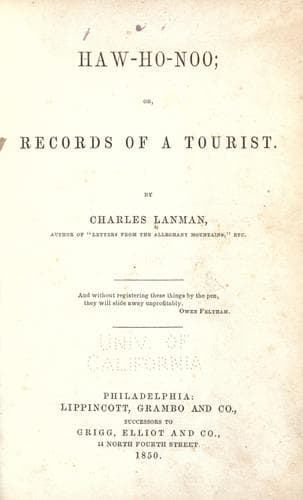
Haw-Ho-Noo; Or, Records of a TouristLanman, Charles
History
Haw-Ho-Noo; Or, Records of a Tourist
Lanman, Charles
Fishing -- North America; United States -- Description and travel
They were so cautious in all their movements, that their footsteps did
not even awaken the sleeping dogs. It so happened, however, that they
were discovered, and that, too, by a young woman, who, according to
ancient custom, was leading a solitary life previous to becoming a
mother. In her wakefulness she saw them pass near her lodge and heard
them speak, but could not understand their words, though she thought
them to be of the Na-do-was tribe. When they had passed, she stole out
of her own wigwam to that of her aged grandmother, whom she informed of
what she had seen and heard. The aged woman only reprimanded her
daughter for her imprudence, and did not heed her words. “But, mother,”
replied the girl, “I speak the truth; the dreaded Na-do-was are in our
village; and if the warriors of the Buffalo Race do not heed the story
of a foolish girl, their women and their children must perish.” The
words of the girl were finally believed, and the warriors of the Crane
and Buffalo tribes prepared themselves for the capture. The war-whoop
echoed to the sky; and the rattling of bows and arrows was heard in
every part of the island. In about an hour, the main shore was lined
with about eight hundred canoes, whose occupants were anxiously waiting
for the appearance of the spies. These desperate men, however, had made
up their minds to try the mettle of their oars to the utmost, and, as
the day was breaking, they launched their canoe from a woody cove, shot
round the island, and started in the direction of the Porcupine
Mountains, which were about sixty miles distant. Soon as they came in
sight of the Chippeways, the latter became quite frantic, and, giving
their accustomed yell, the whole multitude started after them swift as
the flight of gulls. The mighty lake was without a ripple; and the
beautiful fish in its bosom wandered about their rocky haunts in perfect
peace, unconscious of the dreadful strife which was going on above. The
canoes of the pursued and the pursuers moved with magic speed. The
Iroquois were some two miles ahead, and while they strained every nerve
for life, one voice rose high into the air, with a song of invocation to
the spirits of their race for protection; and, in answer to their
petition, a thick fog fell upon the water, and caused great confusion.
One of the Chippeway warriors laid down his paddle, seized his
mysterious rattle (made of deer’s hoof), and, in a strange, wild song,
implored the spirits of his race to clear away the fog, that they might
only see their enemies. The burthen of the song was:—
“Mon e-tou ne bah bah me tah wah
Ke shig ne bah bah me tah goon
Ah bee ne nah wah goom me goon
Men ke che dah awas—awas.”
Which may be translated as follows:—
“Spirit! whom I have always obeyed,
Here cause the skies now to obey,
And place the waters in our power.
We are warriors—away, away.”
Public-domain text, read in full here on John Shaqi.
Reviews
Reviews
No reviews yet
Be the first to share your thoughts on this work.
Elsewhere in the archive
Join the Discussion
Join the discussion
Sign in to leave a comment or review.
Sign InorCreate an account