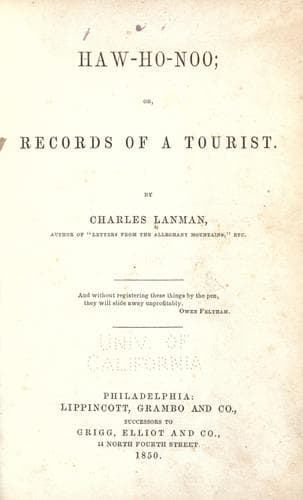
Haw-Ho-Noo; Or, Records of a TouristLanman, Charles
History
Haw-Ho-Noo; Or, Records of a Tourist
Lanman, Charles
Fishing -- North America; United States -- Description and travel
“I am about to die, my brothers, and must speak my mind. To be fortunate
in war is your chief ambition, and because I have been successful you
are unhappy. Is this right? Have you acted like men? I despise you for
your meanness, and I intend to prove to you this night that I am the
bravest man in the nation. The task will cost me my life, but I am
anxious that my nature should be changed and I shall be satisfied. I
intend to enter the Crow village alone, but before departing, I have one
favor to command. If I succeed in destroying that village, and lose my
life, I want you, when I am dead, to cut off my head and protect it with
care. You must then kill one of the largest buffaloes in the country and
cut off his head. You must then bring his body and my head together, and
breathe upon them, when I shall be free to roam in the Spirit-land at
all times, and over our great prairie-land wherever I please. And when
your hearts are troubled with wickedness remember the Lone Buffalo.”
The attack upon the Crow village was successful, but according to his
prophecy the Lone Buffalo received his death wound, and his brother
warriors remembered his parting request. The fate of the hero’s mother
is unknown, but the Indians believe that it is she who annually sends
from the Spirit land the warm winds of spring, which cover the prairies
with grass for the sustenance of the Buffalo race. As to the Lone
Buffalo, he is never seen even by the most cunning hunter, excepting
when the moon is at its full. At such times he is invariably alone,
cropping his food in some remote part of the prairies; and whenever the
heavens resound with the moanings of the thunder, the red man banishes
from his breast every feeling of jealousy, for he believes it to be the
warning voice of the Lone Buffalo.
LEGENDS OF MACKINAW.
The original Indian name of this island was Mich-il-i-mack-i-nack,
signifying the mammoth turtle. It is a beautiful spot of earth, and its
origin is accounted for by the following Ottaway legend:—
Public-domain text, read in full here on John Shaqi.
Reviews
Reviews
No reviews yet
Be the first to share your thoughts on this work.
Elsewhere in the archive
Join the Discussion
Join the discussion
Sign in to leave a comment or review.
Sign InorCreate an account