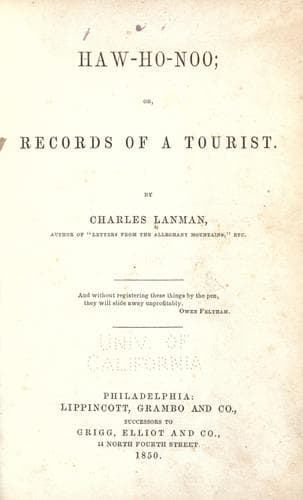
Haw-Ho-Noo; Or, Records of a TouristLanman, Charles
History
Haw-Ho-Noo; Or, Records of a Tourist
Lanman, Charles
Fishing -- North America; United States -- Description and travel
The world was in its prime, and time rolled on with its accustomed
regularity. The tiny streams among the hills and mountains shouted with
joy, and the broad rivers wound their wonted course along the peaceful
valleys. Many a tall oak had grown from the acorn, spread its rich
foliage to the summer winds, decayed with age, and mingled with its
mother earth. The moon and stars had long made the night-skies
beautiful, and guided the Indian hunter through the wilderness. The sun,
which the red man calls the glory of the summer time, had never failed
to appear at his appointed periods. Many generations of men had lived
and passed away.
In process of time the aspect of the world became changed. Brother
quarreled with brother, and cruel wars frequently covered the earth with
blood. The Great Spirit saw all these things and was displeased. A
terrible wind swept over the wilderness, and the red men knew that they
had done wrong, but they lived as if they did not care. Finally a
stranger prophet made his appearance among them, and proclaimed in every
village the news that the human race was to be destroyed. None believed
his words, and the moons of summer again came and disappeared. It was
now the autumn of the year. Many cloudy days had occurred, and then a
total darkness came upon the earth, and the sun seemed to have departed
forever. It was very dark and very cold. Men laid themselves down to
sleep, but they were troubled with unhappy dreams. They arose when they
thought it was time for the day to dawn, but only to see the sky covered
with a darkness deeper than the heaviest cloud. The moon and stars had
all disappeared, and there was constantly a dismal bellowing of thunder
in the upper air. Men now believed that the sun would never return, and
there was great consternation throughout the land. The great men of the
Choctaw nation spoke despondingly to their fellows, and sung their death
songs, but those songs were faintly heard in the gloom of the great
night. It was a most unhappy time indeed, and darkness reigned for a
great while. Men visited each other by torch-light. The grains and
fruits of the land became mouldy, and the wild animals of the forest
became tame and gathered around the watch-fires of the Indians, entering
even into the villages.
Public-domain text, read in full here on John Shaqi.
Reviews
Reviews
No reviews yet
Be the first to share your thoughts on this work.
Elsewhere in the archive
Join the Discussion
Join the discussion
Sign in to leave a comment or review.
Sign InorCreate an account