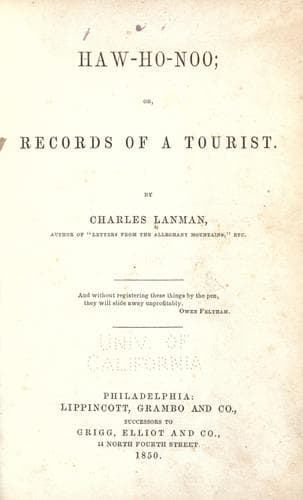
Haw-Ho-Noo; Or, Records of a TouristLanman, Charles
History
Haw-Ho-Noo; Or, Records of a Tourist
Lanman, Charles
Fishing -- North America; United States -- Description and travel
There once lived in the royal Indian town of _E-ya-sho_ (Ya-zoo) the
only son of a war chief, who was eminently distinguished above all his
fellows for his elegant form and noble bearing. The old men of the
nation looked upon him with pride, and said that he was certainly born
to occupy a high position as a warrior. He was also an eloquent orator,
and none ever thought of doubting his courage. But, with all these
qualities, he was not allowed a seat in the councils of his nation,
because he had not distinguished himself in war. The renown of having
slain an enemy he could not claim, nor had he ever been fortunate enough
to take a single prisoner. He was universally beloved, and, as the name
of his childhood had been abandoned according to an ancient custom, and
he had not yet succeeded in winning a name worthy of his ability, he was
known among his kindred as the Nameless Choctaw.
In the town of E-ya-sho there also once lived the most beautiful maiden
of her tribe. She was the daughter of a hunter, and the betrothed of the
Nameless Choctaw. They met often at the great dances, but, because she
hoped to become his bride, she treated him as a stranger. Often, too,
did they meet at the setting of the sun, but then they listened to the
song of the whipporwill or watched the rising of the evening star, when
each could hear the throbbing of the other’s heart. They loved with a
wild passion and were very happy. At such times one thought alone
entered their minds to cast a shadow. It was this: They knew that the
laws of their nation were unalterable, and that she could not become his
bride until he had won a name. She knew that he could always place at
the door of her lodge an abundance of game, and would deck her with the
most beautiful of shells and wampum; but all this availed them nothing;
that he must go upon the war-path was inevitable. She belonged to a
proud family, and she never would consent to marry a man who had not a
loud sounding name, and who could not sit in the councils of her people.
She was willing to become his bride at any time, and therefore left him,
by his prowess, to decide upon that time.
It was now midsummer and the evening hour. The Nameless Lover had met
his promised bride upon the summit of a small hill, covered with pines.
From the centre of a neighboring plain arose the smoke of a large
watch-fire, around which were dancing a party of four hundred warriors.
They had planned an expedition against the Osages, and the present was
the fourth and last night of the preparation ceremonies. Up to that
evening the Nameless Choctaw had been the leader in the dances, and even
now his absence was only temporary, for he had stolen away to express
his parting vows to his beloved. The last embrace was given, and then
the maiden was alone upon the hill-top, looking down in sadness upon the
dancing warriors, among whom she beheld none who commanded more
attention than the being whom she loved.
Public-domain text, read in full here on John Shaqi.
Reviews
Reviews
No reviews yet
Be the first to share your thoughts on this work.
Elsewhere in the archive
Join the Discussion
Join the discussion
Sign in to leave a comment or review.
Sign InorCreate an account