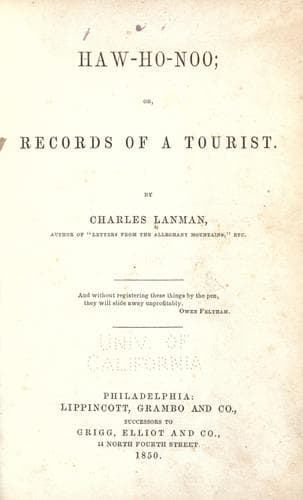
Haw-Ho-Noo; Or, Records of a TouristLanman, Charles
History
Haw-Ho-Noo; Or, Records of a Tourist
Lanman, Charles
Fishing -- North America; United States -- Description and travel
There was a time when all the Indian tribes in the world were at war
with the great Seneca nation, whose hunting grounds were on the borders
of Lake Ontario. So fearful had they become of their enemies, that the
bravest hunters and warriors never left their wig-wams without bending
their bows, and little children were not permitted by their mothers to
gather berries or hickory nuts in the neighboring woods. The head chief
of the nation at that time, was _Sa-go-you-wat-ha_, or _Always Awake_.
He was a good man, and being sorely grieved at the unhappiness of his
people, he conceived the idea of securing a permanent peace. It was
true, he said, that his father had been a cruel and unpopular chief, but
he did not think it right that the generation which followed his father
should be made miserable for crimes never committed by them. And
therefore it was that he prayed to the _Great Ha-nee_ to tell him, in a
dream, what he must do to accomplish his end. Night came, and in spite
of his name, _Always Awake_ fell into a deep sleep and had a dream.
He was told that in the direction whence came the warm winds of summer,
and distant from his village a journey of one moon, there was a very
large mountain. On the summit of that mountain, as he was told, were
living a few people from all the nations of the earth, excepting the
Senecas. The place alluded to was called the _Mountain of Refuge_, and
it was so sacred a place, that its soil had never been wet with human
blood, and the people who lived there, were the peculiar favorites of
the Great Ha-nee, and were the law makers of the world. The dream also
told the Seneca chief, that he could secure a permanent peace only by
visiting the sacred mountain; but as the intervening distance was so
great, and his trail would be only among enemies, the dangers of the
expedition would be very numerous. By traveling at night, however, and
sleeping in the day time, the task might be accomplished, and he was at
liberty to try _his_ fortune.
Public-domain text, read in full here on John Shaqi.
Reviews
Reviews
No reviews yet
Be the first to share your thoughts on this work.
Elsewhere in the archive
Join the Discussion
Join the discussion
Sign in to leave a comment or review.
Sign InorCreate an account