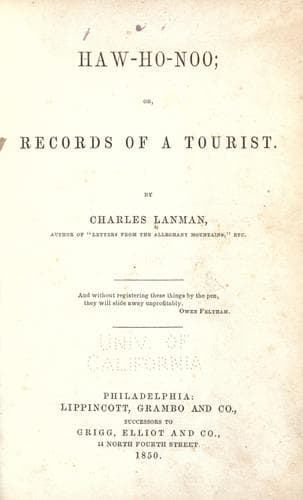
Haw-Ho-Noo; Or, Records of a TouristLanman, Charles
History
Haw-Ho-Noo; Or, Records of a Tourist
Lanman, Charles
Fishing -- North America; United States -- Description and travel
In the great wilderness of the north, midway between Hudson’s Bay and
Lake Ontario, lies a beautiful sheet of water called Stone Lake. It is
surrounded with hills, which are covered with a dense forest, and the
length thereof is about twelve miles. On the shore of this lake there
stood, in the olden time, an Ottawa village, and the most notorious
vagabond in said village was an old bachelor. He was a kind-hearted
rogue, and though he pretended to have a cabin of his own, he spent the
most of his time lounging about the wigwams of his friends, where he was
treated with the attention usually bestowed upon the oldest dog of an
Indian village. The low cunning for which he was distinguished made him
the laughing-stock of all who knew him, and his proverbial cowardice had
won for him the contempt of all the hunters and warriors. Whenever a war
party was convened for the purpose of pursuing an enemy, Wis-ka-go-twa,
or the White Liver, always happened to be in the woods; but when they
returned, singing their songs of victory, the vagabond bachelor
generally mingled conspicuously with the victors.
But, in process of time, Wis-ka-go-twa took it into his head to get
married, and from that moment began the troubles of his life. As soon as
his resolution had become known among the young women of the village,
they came together in secret council, and unanimously agreed that not
one of them would ever listen to the expected proposals of the bachelor,
for they thought him too great a coward to enjoy the pleasures of
matrimony. Years elapsed, and the vagabond was still in the enjoyment of
his bachelorhood.
In the meanwhile a beautiful maiden, named Muck-o-wiss, or the
Whipporwill, had budded into the full maturity of life. She was the
chief attraction of the village, and the heart of many a brave warrior
and expert hunter had been humbled beneath her influence. Among those
who had entered her lodge in the quiet night, and whispered the story of
his love, was Wis-ka-go-twa. She deigned not to reply to his avowals,
and he became unhappy. He asked the consent of her father to their
union, and he said that he had no objections provided the daughter was
willing. It so happened, however, that the maiden was not willing, for
she was a member of that female confederacy which had doomed the
vagabond lover to the miseries of single life. Time passed on, and he
was the victim of a settled melancholy.
Public-domain text, read in full here on John Shaqi.
Reviews
Reviews
No reviews yet
Be the first to share your thoughts on this work.
Elsewhere in the archive
Join the Discussion
Join the discussion
Sign in to leave a comment or review.
Sign InorCreate an account