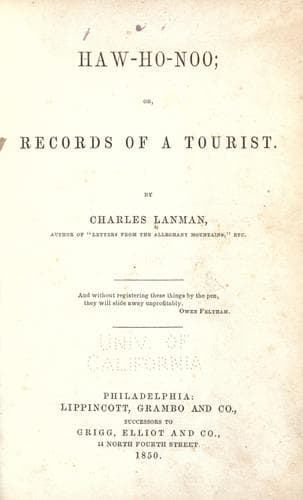
Haw-Ho-Noo; Or, Records of a TouristLanman, Charles
History
Haw-Ho-Noo; Or, Records of a Tourist
Lanman, Charles
Fishing -- North America; United States -- Description and travel
“The Comet constructed at Pittsburg in the spring of 1813, for Mr.
Smith, is 52 feet long and 8 feet beam, cylinder 6¼ inches diameter,
18 inches stroke, vibrating motion, no condenser or air-pump. The
water wheel in the stern, 6 feet diameter, 8 paddles 2 feet 6 inches
long and 11 inches wide. The boiler 14 feet long, 2 feet 6 inches
wide, with a flue high, steam from 50 to 60 pounds to the inch square,
20 to 30 double stroke a minute. _This is Evans’s idea of steam power
by high steam. It was the Marquis of Worcester’s 120 years ago; and
Mr. Watts 30 years ago tried and abandoned it._”
Another curious memorandum, which is without a caption, is as follows:—
“10,000 acres of pine land on Egg Harbor River, the property of
Ebenezer Tucker, of Tuckerton, Burlington county, known by the name of
Judge Tucker. Should this land produce only ten cords to an acre, it
will be 1,000 to 100 acres, or 100,000 cords. The steam-boats from New
York will use 1,500 cords a year, or, for New York and Albany, 3,000
cords; thence 20 years would consume the wood of 6,000 acres, in which
time, the first cut would grow up, and thus this 10,000 acres would
perpetually supply the steamboats.”
The longest record in this account book (like all the others) is in
Fulton’s own handwriting, and entitled “_Livingston and Fulton vs. Lake
Champlain boat_.” It occupies four closely written pages, is dated
October 12, 1810, and signed by Robert R. Livingston. It is an
interesting document, but as the volume in question is about to be
presented to the New York Historical Society, I will leave it with that
honorable body to give it to the public in some of their interesting
publications.
But enough of this episode. Though Rock Creek may have been the
birthplace of Fulton’s steamboat idea, yet it is certain that, with all
his fiery monsters at our command, we could never ascend this beautiful
stream without the use of our legs, and we will therefore rejoin our
companion and continue our pedestrian pilgrimage.
Public-domain text, read in full here on John Shaqi.
Reviews
Reviews
No reviews yet
Be the first to share your thoughts on this work.
Elsewhere in the archive
Join the Discussion
Join the discussion
Sign in to leave a comment or review.
Sign InorCreate an account